
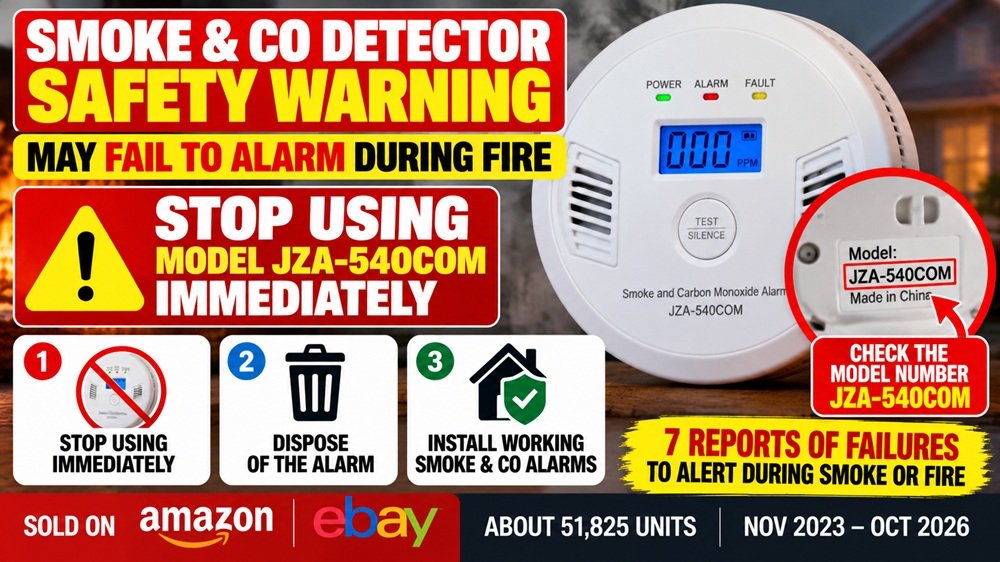
If you bought a combination smoke and carbon monoxide detector from Amazon or eBay, check the label before trusting it to protect your home tonight.
The U.S. Consumer Product Safety Commission, or CPSC, is warning consumers to immediately stop using model JZA-540COM combination smoke and carbon monoxide alarms sold under several brand names.
The problem is especially serious because these are life-safety devices: CPSC says the alarms can fail to sound when hazardous smoke or fire is present.
About 51,825 units are covered by the warning.
CPSC is aware of seven reports of these alarms failing to alert in the presence of smoke or fire.
First, check the model number: JZA-540COM
The safest way to identify the affected detector is by its model number:
JZA-540COM
CPSC says the affected combination alarms were sold under brand names including:
- JuzhiAnn
- Yfwsrecinoe
- JAEHSK / JAEHSKA
The products are white plastic combination smoke and carbon monoxide detectors with a digital display and were sold as individual units and in multipacks.
Because brand spelling can vary across marketplace listings and even product descriptions, use model JZA-540COM as your primary identifier.
Where were these detectors sold?
CPSC says the affected alarms were sold online through:
- Amazon.com
- eBay.com
They were sold from approximately November 2023 through October 2026 for prices ranging from about $11 to $107, depending on the package.
If you do not remember the brand, search your Amazon or eBay order history for:
- JZA-540COM
- JuzhiAnn
- Yfwsrecinoe
- Combination smoke and carbon monoxide detector
Why is this warning more serious than an ordinary product defect?
A smoke alarm is supposed to give you time to escape a fire.
If the detector fails to sound, you may not realize dangerous smoke is building until conditions have already become much more serious.
That is why CPSC is not advising consumers to simply watch the product carefully or test it one more time.
The agency says to stop using the affected detectors immediately.
What should you do if you have model JZA-540COM?
CPSC’s instructions are direct:
- Stop using the detector immediately.
- Dispose of the affected product.
- Install working smoke alarms and carbon monoxide detectors.
- Do not sell or give the affected detector to someone else.
Do not leave your home without working alarms while you wait to decide what to do with the old unit.
The priority is to restore reliable smoke and carbon monoxide protection as quickly as possible.
There is currently no official recall refund or replacement program
This is not a normal cooperative recall.
CPSC says the retailer, Shenzhen Laijinhe Trading Co., Ltd., doing business as Yfwsrecinoe US, has been unresponsive to the agency’s request to recall the products.
As a result, the October 29 CPSC warning does not announce a manufacturer-funded refund, repair, or replacement program.
You may still choose to contact Amazon, eBay, or the seller and ask whether any marketplace or customer-service remedy is available for your particular order.
But do not delay replacing the detector while waiting for a refund decision.
Don’t test it with real smoke and assume that proves it is safe
A consumer may be tempted to press the test button, hear a beep, and conclude that the detector works properly.
That is not a good reason to ignore the CPSC warning.
A test button generally confirms that certain electronics and the audible alarm can operate. It does not necessarily prove that the detector will correctly sense hazardous smoke or carbon monoxide under real-world conditions.
If your detector matches the affected model, follow the CPSC stop-use instruction rather than trying to personally certify that the unit is safe.
What should you look for when buying the replacement?
CPSC recommends buying smoke alarms and carbon monoxide detectors that meet applicable UL safety standards.
Look for products that meet:
- UL 217 for smoke alarms
- UL 2034 for carbon monoxide alarms
If you are buying another combination smoke/CO unit online, read the actual product certification information rather than relying only on words such as “certified,” “safe,” or “approved” in the marketplace title.
Where should smoke and CO alarms be installed?
CPSC recommends having smoke alarms and carbon monoxide detectors on each level of the home and outside separate sleeping areas.
The alarms should be battery operated or have battery backup so they can continue operating during a power failure.
Follow the manufacturer’s installation instructions because placement requirements for smoke and CO detection can differ.
Don’t forget to test the replacement alarms
Buying a safer alarm is only the first step.
CPSC recommends testing smoke and CO alarms frequently and replacing batteries when needed.
A useful home-safety routine is:
Check model → Replace unsafe alarm → Install correctly → Test regularly → Replace batteries as needed.
If your home has several detectors, check all of them rather than assuming they are different models.
What if you bought a different combination smoke/CO detector online?
This particular warning applies to model JZA-540COM.
Do not assume every inexpensive detector sold online is defective.
At the same time, CPSC has issued other warnings involving different combination smoke and carbon monoxide alarms that can fail to alert consumers.
For example, CPSC issued a separate October 29 warning involving GuardianSense/KLTseanife model YHW-542COM-R.
So if you own another unfamiliar marketplace brand, check the exact model against the CPSC recall and product-safety-warning database rather than relying only on appearance.
What if you rent your home?
If the affected detector belongs to your landlord or property manager, notify them immediately and identify the exact model.
Do not assume another alarm elsewhere in the property makes a nonworking unit acceptable.
Local smoke and carbon monoxide alarm requirements vary by jurisdiction, so landlords and tenants may also have specific responsibilities under state or local law.
What if the alarm already failed during a smoke or fire incident?
If you experienced a safety incident involving this detector, CPSC asks consumers to report it through SaferProducts.gov.
Keep any useful documentation, including:
- Photos of the detector
- The model label
- Amazon or eBay order information
- The approximate date of the incident
- Any photos or records showing what occurred
Do not continue using the detector just because the incident did not cause an injury.
The SavingQueen takeaway
This is one of those product warnings where the most important action takes less than a minute:
Turn the detector over and check the model number.
If it says:
JZA-540COM
CPSC says:
Stop using → Dispose → Replace with working smoke and CO alarms → Do not sell or give away.
And unlike many recalls, there is currently no official manufacturer refund or replacement remedy because the retailer has not responded to CPSC’s recall request.
That makes replacement your immediate priority—not waiting for reimbursement.
A smoke alarm or carbon monoxide detector is one product where “probably works” is not a good enough standard.
CPSC warning date: October 29, 2026
Warning number: 27-052
Product: Combination Smoke and Carbon Monoxide Alarm
Model: JZA-540COM
Brands: JuzhiAnn, Yfwsrecinoe, JAEHSK/JAEHSKA
Units: About 51,825
Reported failures: 7
Sold at: Amazon.com and eBay.com
Sales period: November 2023–October 2026
Price: About $11–$107
Consumer action: Stop use, dispose, and install working alarms
Official recall remedy: None currently announced