
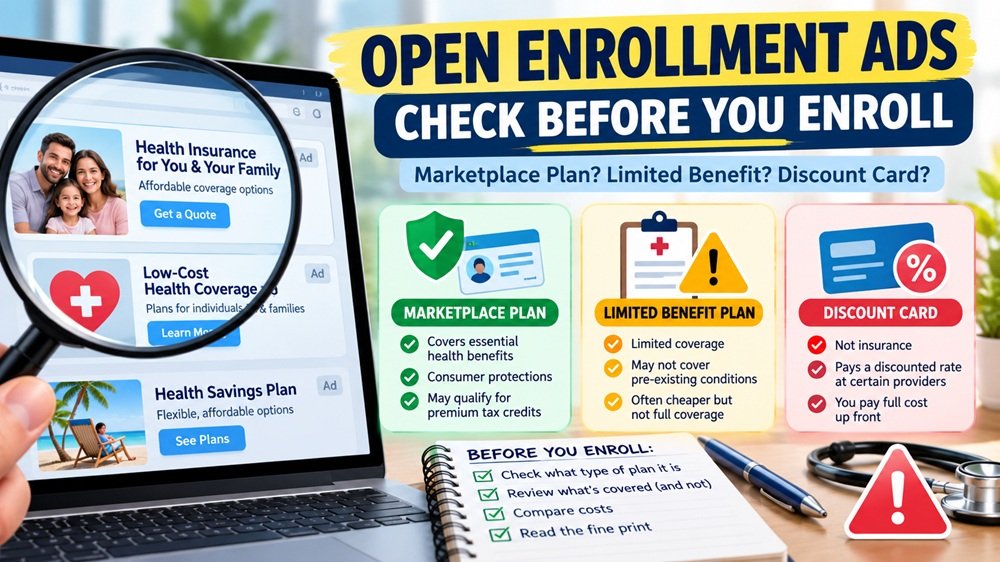
If you’ve searched online for health insurance recently, you’ve probably seen ads promising things like:
“Affordable health coverage starting today.”
“Get comprehensive insurance for less.”
“See if you qualify for government health benefits.”
Some of those offers may lead to legitimate insurance products.
Others may lead to a plan with very limited benefits, a medical discount program that isn’t insurance at all, or even someone impersonating a government agency or well-known insurance company.
That’s why the Federal Trade Commission issued a new consumer warning on October 29, 2026, just before the Health Insurance Marketplace Open Enrollment period begins.
For 2027 Marketplace coverage, Open Enrollment starts November 1, 2026 and runs through January 15, 2027.
Before you click an ad, give someone your Social Security number, or enter a credit card, use these seven checks.
Check #1: Start at HealthCare.gov instead of an advertisement
The easiest way to reduce confusion is to start from the official source.
For Health Insurance Marketplace coverage, the FTC recommends beginning at:
HealthCare.gov
or calling the official Marketplace Call Center at:
1-800-318-2596
If your state operates its own official Marketplace, HealthCare.gov can direct you to the appropriate state system.
This is safer than starting with a sponsored search result, social-media ad, unsolicited text message, or phone call.
A paid advertisement may be legitimate, but paying for the top position in a search result does not make a company part of the federal government or the official Marketplace.
Check #2: Look for “Ad” or “Sponsored” before you click
Search engines often place paid results above ordinary search results.
The FTC specifically warns consumers to look for small labels such as:
Ad
Sponsored
Those labels mean someone paid to appear there.
They do not mean the government approved the company, the plan qualifies for Marketplace subsidies, or the coverage meets the same standards as an ACA Marketplace plan.
If you’re trying to reach the official Marketplace, scroll carefully and check the web address before clicking.
Check #3: Is it actual health insurance—or a medical discount card?
This is one of the most important distinctions.
A medical discount program is not the same thing as health insurance.
A discount card may give members negotiated discounts with participating doctors, pharmacies, dentists, or other providers.
But it generally does not work like major medical insurance that pays covered claims according to a policy’s benefits, deductible, copays, coinsurance, and out-of-pocket limits.
If an advertisement uses words such as:
- Health benefits
- Affordable healthcare
- Medical savings
- Healthcare membership
- Discount health plan
don’t assume you’re buying insurance.
Ask directly:
“Is this an insurance policy, or is it a medical discount program?”
If the answer is vague, stop before paying.
Check #4: Is it comprehensive insurance—or a limited-benefit plan?
A product can technically provide insurance benefits and still offer much less protection than you expected.
Some limited-benefit products may pay only fixed amounts for specified services.
For example, a plan might pay a set dollar amount for a hospital stay rather than covering the hospital bill in the same way a comprehensive major-medical plan would.
Before enrolling, find out:
- What services are actually covered?
- What services are excluded?
- Is there an annual or benefit limit?
- Are prescription drugs covered?
- Does the plan cover hospitalization?
- What is the deductible?
- What is the maximum out-of-pocket cost?
- Is there a provider network?
The FTC recently reminded health-plan marketers that they must not misrepresent a limited healthcare product as comprehensive medical insurance.
Check #5: Compare the plan through the official Marketplace
If you’re shopping for ACA Marketplace coverage, don’t evaluate an insurance advertisement by monthly premium alone.
Starting November 1, HealthCare.gov allows consumers to apply for 2027 coverage and update expected household and income information.
That matters because your actual Marketplace cost may depend on whether you qualify for savings.
Compare:
- Monthly premium
- Deductible
- Copays and coinsurance
- Out-of-pocket maximum
- Prescription coverage
- Provider network
- Whether your doctors and hospitals participate
A plan advertising a very low monthly payment may not be the least expensive option once you consider what happens when you actually need medical care.
Check #6: Be skeptical of “free money” and special-benefit promises
FTC staff has warned health-plan marketers about advertising that can mislead consumers about plan costs, benefits, and incentives.
Be cautious if the advertisement focuses heavily on benefits such as:
- Cash allowances
- Free groceries
- Gift cards
- Large rebates
- “Government money”
- Benefits available to “everyone”
instead of clearly explaining the health coverage itself.
A legitimate plan can have additional benefits or incentives, but the headline offer should not distract you from understanding what insurance you’re actually buying.
Ask for the plan documents and read the coverage limitations before enrolling.
Check #7: Don’t give personal information to an unexpected caller
Health-insurance shopping involves unusually sensitive information.
A caller or website may ask for:
- Your name and address
- Date of birth
- Household income
- Social Security number
- Current insurance information
- Credit or debit card number
Those details can be valuable to an identity thief.
If someone contacts you unexpectedly claiming to represent HealthCare.gov, a government program, or a major insurance company, don’t rely on the phone number or link they provide.
Go to the official website or call a number you independently verify.
A prerecorded health-insurance sales call is a major warning sign
The FTC’s October 29 alert also highlights another useful clue.
The agency says prerecorded robocalls marketing health insurance are illegal.
So if an unexpected automated voice tells you:
“You have been pre-approved for affordable government health coverage. Press 1 to enroll.”
do not treat that message as proof of a legitimate insurance offer.
Hang up rather than providing personal information through the automated call.
Don’t confuse Marketplace Open Enrollment with Medicare Open Enrollment
The terms sound similar but refer to different programs.
The Health Insurance Marketplace Open Enrollment discussed here generally applies to people shopping for individual or family coverage through HealthCare.gov or a state Marketplace.
Medicare has its own enrollment rules and official website at:
Medicare.gov
If you are looking for Medicare coverage, do not assume a HealthCare.gov advertisement or Marketplace enrollment message applies to you.
What are the important 2027 Marketplace dates?
According to HealthCare.gov, the current schedule is:
November 1, 2026
Open Enrollment begins. You can enroll, renew, or change Marketplace coverage for 2027.
December 15, 2026
Last day to enroll or change plans for coverage beginning January 1.
January 1, 2027
Coverage begins for consumers who complete enrollment by December 15 and pay the required first premium.
January 15, 2027
Marketplace Open Enrollment ends.
February 1, 2027
Coverage generally begins for people enrolling or changing plans from December 16 through January 15, assuming the first premium is paid.
After January 15, consumers generally need to qualify for a Special Enrollment Period to enroll in or change Marketplace coverage.
What if an agent says, “You have to enroll right now”?
Pressure is another reason to slow down.
A salesperson may say:
“This rate disappears today.”
“You must give me your card number while we’re on the phone.”
“Don’t go to HealthCare.gov—you’ll lose the special price.”
Do not let urgency prevent you from verifying the plan.
If the plan is being presented as Marketplace coverage, you should be able to compare official Marketplace options independently.
If the product is outside the Marketplace, ask for the insurer’s name, policy documents, exclusions, network, benefits, cancellation rules, and total cost before paying.
Use free official enrollment help if you need it
You do not have to figure everything out alone or rely on whoever bought the first search advertisement.
HealthCare.gov provides a Find Local Help service where consumers can locate trained people and organizations that assist with Marketplace applications and plan comparisons.
Start through HealthCare.gov so you know you’re using an official Marketplace resource.
What if you already paid for something that isn’t what you expected?
First, identify exactly what you purchased.
Find the enrollment documents, insurance card, emails, receipt, and company name.
Determine whether you bought:
- Marketplace health insurance
- Other major medical insurance
- A limited-benefit insurance product
- A medical discount membership
- Something that does not appear to be legitimate at all
If you believe an advertisement misrepresented the product, preserve screenshots, emails, texts, and payment records.
You can report potentially deceptive advertising or scams to the FTC at:
ReportFraud.ftc.gov
You may also need to contact your state insurance regulator depending on the product and problem involved.
The SavingQueen 60-second health insurance ad check
Before entering personal information or paying, ask:
1. Where am I?
Is this HealthCare.gov, an official state Marketplace, an insurer, or simply an advertisement?
2. What am I buying?
Comprehensive insurance, limited-benefit insurance, or a discount card?
3. What does it actually cover?
Hospital, doctors, prescriptions, deductible, network, and out-of-pocket costs.
4. What does the official Marketplace show?
Compare before deciding.
5. Why is the salesperson rushing me?
Don’t let urgency replace verification.
6. Who is asking for my personal information?
Verify independently before sharing SSN or payment details.
7. Can I confirm the offer from an official source?
If not, don’t pay yet.
The SavingQueen takeaway
Open Enrollment creates a simple problem for consumers: legitimate health insurance, limited-benefit products, discount programs, lead-generation websites, advertisements, and outright scams can all appear in the same search results.
The safest strategy isn’t to become an insurance expert before clicking anything.
It’s to control where you start.
Start at HealthCare.gov → Compare official plans → Understand what the product is → Verify coverage → Then provide personal information or payment.
If an ad appears first in Google, Facebook, Instagram, or another platform, remember:
“Sponsored” means someone paid for the placement. It does not mean the government approved the plan.
For 2027 Marketplace coverage, Open Enrollment begins November 1, 2026. Taking a few extra minutes to verify the plan before enrolling can prevent a much more expensive surprise when you actually need medical care.
FTC consumer alert: October 29, 2026
2027 Marketplace Open Enrollment: November 1, 2026–January 15, 2027
Official Marketplace: HealthCare.gov
Marketplace Call Center: 1-800-318-2596
Fraud reports: ReportFraud.ftc.gov