
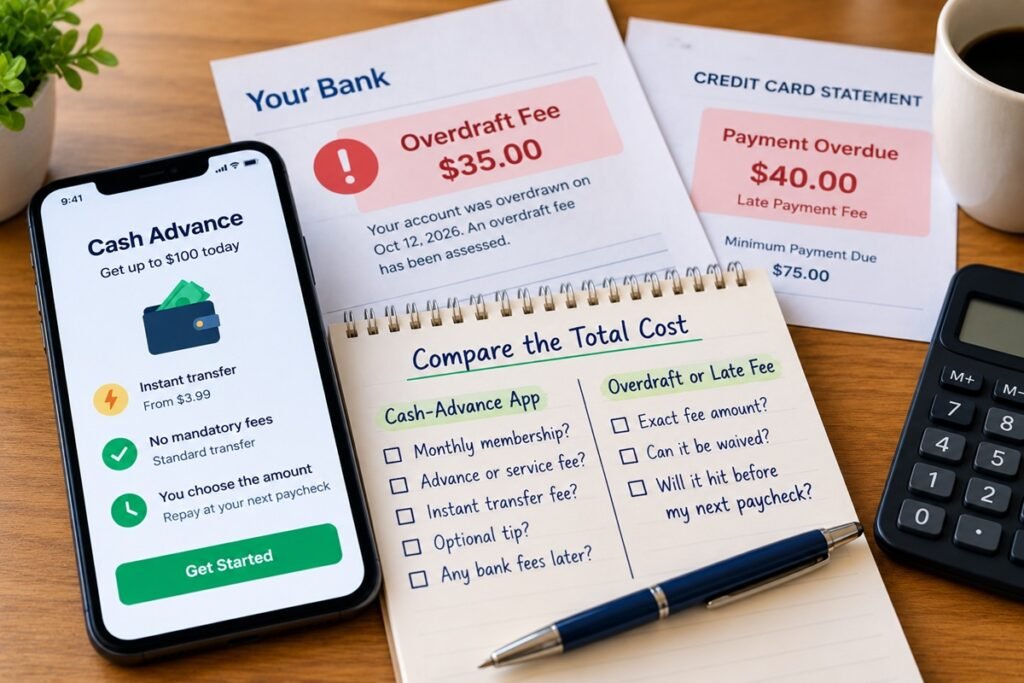
Depends. A cash-advance app can be cheaper if its total cost is lower than the overdraft or late fee you are about to avoid and repaying the advance will not create another shortfall on payday.
But the cheapest option may also be $0. Some apps offer free slower transfers, some banks offer no-fee overdraft programs, and a credit-card issuer may agree to waive a late fee if you ask.
The useful comparison is not “cash-advance app versus bank.” It is:
All-in app cost versus the exact fee you can actually prevent.
Start With This Simple Cost Test
Before accepting an advance, add up:
App cost = required membership + advance/service fee + expedited-transfer fee + optional tip you choose + any bank fee triggered when the advance is repaid
Then compare that number with:
Cost avoided = overdraft fee or late-payment cost you would otherwise pay
If the app costs less, arrives in time, and you can repay it without causing another shortage, it may save money.
If the fee you are avoiding is $0, can be waived, or is smaller than the app’s total cost, skip the paid advance.
Cash-Advance Apps Do Not All Charge the Same Way
“Cash-advance app” is useful shorthand, but the products themselves can work differently. Some provide earned wage access, while others use deposit-account overdraft features or other structures.
The fee structure matters more than the label.
Example: EarnIn
EarnIn currently advertises standard Cash Out transfers with no mandatory fee. Standard transfers generally take one to two business days. Its optional Lightning Speed service delivers money faster and currently starts at $3.99 per transfer. Tips are optional and can be $0.[1]
Fees can differ by state and product, so the amount displayed before confirming the transfer is the number that matters.
If a free standard transfer will arrive before the bill or transaction hits, paying for instant delivery would not save anything.
Example: Dave ExtraCash
Dave’s current ExtraCash disclosures show a different structure. Eligible users may pay an overdraft-service fee equal to 5% of the advance, with a $5 minimum. Dave also lists a monthly membership of up to $5, and transferring ExtraCash to an external debit card can add a 1.5% express fee.[2]
Transfers to Dave Checking can avoid the external-card express fee, while a slower ACH transfer to an external bank can also be free of the express fee.[2]
That is why comparing only one advertised fee can be misleading.
Example 1: You Need $100 to Avoid a $10 Overdraft Fee
Bank of America’s current consumer checking information provides a useful real-world comparison. Under its Standard overdraft setting, the bank lists a $10 overdraft item fee when it pays an eligible transaction that overdraws the account.[3]
Suppose you are $100 short and need the money quickly.
| Option | Illustrative Cost | Difference vs. $10 Overdraft Fee |
|---|---|---|
| EarnIn standard transfer | $0 mandatory fee | Saves $10 if it arrives in time |
| EarnIn Lightning Speed at starting price | $3.99 | Saves $6.01 |
| Bank of America single overdraft item | $10 | Baseline |
In that narrow scenario, a $3.99 instant transfer would be cheaper than a $10 overdraft fee.
But there are two important catches.
First, the $3.99 figure is a starting price, not a universal EarnIn fee for every consumer or state.
Second, you are not saving $6.01 if you would never have been charged the overdraft fee in the first place.
Sometimes the Overdraft Fee Is Already $0
Capital One’s current 360 Checking terms show why you need to check your own bank before paying an app.
Eligible customers can enroll in its No-Fee Overdraft service. Capital One says it does not charge an overdraft fee when it chooses to cover an eligible transaction, although qualification and approval conditions apply.[4]
Capital One also offers a free savings-transfer option for eligible customers.
If your bank would cover the transaction for $0, paying $3.99, $6.50, or $11.50 to avoid an “overdraft fee” would make no financial sense.
Save-or-Skip rule: Check your bank’s actual overdraft setting before assuming you are about to pay a traditional $30-or-more fee.
Example 2: A $100 Dave Advance Can Cost More Than One $10 Overdraft
Consider a hypothetical $100 ExtraCash transaction using Dave’s currently disclosed fees.
A 5% service fee on $100 equals $5. Sending the money to an external debit card would add another 1.5%, or $1.50.
That creates a transaction-related cost of:
$5 + $1.50 = $6.50
If you also signed up for a $5 monthly Dave membership solely to get that advance, your total monthly cost attributable to this one use could be as much as:
$5 membership + $5 service fee + $1.50 express fee = $11.50
Against a single $10 overdraft fee, that version would cost $1.50 more.
If you were already paying the membership for other reasons, however, the marginal cost of this particular $100 transfer would be closer to $6.50.
Same app. Same advance. Different answer depending on which costs actually apply to you.
What About Using an App to Avoid a Credit-Card Late Fee?
This can produce a larger potential savings—but again, use your actual card terms.
For example, current pricing terms for one Chase credit card list a late-payment fee of up to $40.[5]
If your particular card would charge $40 and a $3.99 expedited advance truly gets your minimum payment there on time, the simple fee comparison looks like this:
$40 late fee − $3.99 transfer fee = $36.01 potential savings
Even the hypothetical $11.50 Dave example would be cheaper than a $40 late fee by $28.50.
But “up to $40” is not the same as “everyone pays $40.” Credit-card late fees vary by issuer, account, payment amount, and circumstances.
Also, do not assume that credit-card late fees are universally capped at $8. The CFPB’s 2024 rule creating an $8 safe harbor for certain large issuers was vacated by a federal court in April 2025.[6]
Before Paying an App Fee, Ask for a Waiver
If the bill is a credit card, one phone call may beat both choices.
The Consumer Financial Protection Bureau says that if your card payment was late, you can contact the card company and ask whether it will waive the late fee.[7]
There is no guarantee the issuer will say yes.
But compare these possibilities:
| Option | Possible Cost |
|---|---|
| Issuer agrees to waive fee | $0 |
| Free standard app transfer arrives in time | $0 mandatory fee |
| Paid instant app transfer | Varies |
| Late fee | Varies by account |
If the creditor will give you an extra day, change the due date, or waive the fee, borrowing money just to avoid the charge may be unnecessary.
The Biggest Hidden Cost: What Happens on Repayment Day?
This is the part that deserves more attention than the headline fee.
An advance may solve Wednesday’s shortage by moving it to Friday.
If the app collects $100 plus fees from your next paycheck and that leaves too little for rent, groceries, utilities, or another automatic payment, you have not eliminated the shortfall. You have moved it.
Some app agreements specifically warn that repayment or settlement transfers can potentially contribute to an overdraft at the linked bank.
Dave’s ExtraCash agreement, for example, says its settlement system may transfer funds from linked accounts and that the company cannot guarantee an overdraft will not occur as part of that process.[8]
Before confirming an advance, do this second calculation:
Next paycheck − app repayment − bills due before following paycheck = cash remaining
If that number is negative, the app is probably postponing the problem rather than fixing it.
A $3.99 Fee Can Still Add Up if You Use It Every Payday
Small fees feel harmless because the dollar amount is low.
Frequency changes the picture.
Using a $3.99 expedited transfer twice a month would cost:
$3.99 × 2 = $7.98 per month
Over 12 months:
$7.98 × 12 = $95.76 per year
Now consider a hypothetical Dave user who takes two $100 advances each month, pays a $5 service fee and $1.50 external-card express fee on each, and also pays a $5 monthly membership:
($6.50 × 2) + $5 = $18 per month
Over a year:
$18 × 12 = $216
Those examples do not mean everyone will pay those amounts. They show why the question changes when an emergency tool becomes a regular part of every pay cycle.
Read the “Instant” Promise Carefully
Speed matters when the whole purpose of an advance is avoiding a fee today.
A free transfer that arrives after the payment deadline may not help.
At the same time, paying for instant delivery is only worthwhile if you actually need the speed.
The FTC’s recent case involving cash-advance company Cleo is a useful reminder to verify both timing and total cost. The FTC alleged that Cleo misled consumers about advance amounts and timing, charged additional fees for faster advances, and made subscriptions difficult to cancel. In October 2026, the FTC began returning more than $15.8 million to affected consumers.[9]
That case does not mean every cash-advance app behaves the same way. It does mean you should read what the app promises before paying extra for speed.
Use This 5-Number Test Before Taking an Advance
You can make the decision quickly if you know five numbers:
- How much cash do you actually need?
- What mandatory app fee applies?
- What will faster delivery cost?
- What exact overdraft or late fee are you avoiding?
- How much money will remain after the app is repaid?
If you cannot answer all five, do not rely on the advertised advance amount alone.
When a Cash-Advance App Is More Likely to Save Money
A cash-advance app can make sense when:
- The expense is a genuine one-time timing mismatch.
- The all-in app cost is clearly lower than the verified fee you will avoid.
- The transfer will arrive before the transaction or payment deadline.
- You do not need to pay an unnecessary subscription or expedited fee.
- Your next paycheck comfortably covers the repayment and upcoming bills.
When to Skip the Advance
Skip—or at least reconsider—the app when:
- Your bank offers no-fee overdraft or a free linked-savings transfer.
- Your creditor will waive the late fee.
- A free transfer will arrive soon enough.
- Subscription and express fees make the app more expensive than the fee avoided.
- The repayment will leave you short again on your next payday.
- You find yourself taking another advance every time the previous one is repaid.
The Bottom Line
Depends: a cash-advance app can absolutely cost less than an overdraft or late-payment fee, but only when the total app cost is lower than the real fee avoided.
A $3.99 expedited transfer may be a sensible trade if it prevents a verified $10 or $40 charge.
It is a bad trade if your bank would cover the transaction for free, the creditor would waive the fee, or subscriptions and transfer charges push the app cost above the charge you were trying to avoid.
And if paying the advance back will leave you short again next payday, the cheapest move may be to solve the bill timing directly rather than paying repeatedly to move the shortage from one date to another.
Information verified October 20, 2026. Cash-advance, earned-wage-access, bank overdraft, subscription, transfer, and late-payment terms can change and may vary by state, account, bank partner, and user. Check the exact fees displayed before completing a transaction.
[1] EarnIn says standard Cash Out transfers have no mandatory fee and generally take one to two business days, while optional Lightning Speed currently starts at $3.99; tips are optional. State-specific pricing can differ. EarnIn
[2] Dave’s current disclosures list an ExtraCash service fee of 5% with a $5 minimum, membership of up to $5 per month, and an optional 1.5% external debit-card express fee. Its support materials also describe free transfers to Dave Checking and free slower ACH transfers. Dave
[3] Bank of America’s current consumer checking information lists a $10 overdraft item fee under its Standard setting when the bank pays an eligible item that overdraws the account. Bank of America
[4] Capital One’s May 2026 360 Checking disclosures include No-Fee Overdraft and free savings-transfer options, subject to eligibility and the bank’s discretion about whether to pay an overdraft. Capital One
[5] Current pricing terms for one Chase credit card list a late-payment fee of up to $40; that figure is an account-specific example, not a universal card fee. Chase
[6] The CFPB confirms that its 2024 $8 credit-card late-fee rule was vacated by court order on April 15, 2025. Consumer Financial Protection Bureau
[7] CFPB consumer guidance says cardholders can ask an issuer to waive a late fee after a late payment. Consumer Financial Protection Bureau
[8] Dave’s ExtraCash agreement describes automatic balance-settlement transfers and states that it cannot guarantee those transfers will not produce an overdraft at a linked account. Dave
[9] The FTC announced in October 2026 that it was returning more than $15.8 million to Cleo AI customers following allegations concerning advance amounts, delivery timing, fees, and subscription cancellation. Federal Trade Commission