
Switching your restaurant’s point-of-sale system may sound simple: choose a new provider, cancel the old service, and move on.
But the contract you signed months—or even years—ago can make that switch much more expensive than expected.
A new federal lawsuit against Toast is a timely reminder for restaurant owners to check the fine print before canceling a POS system, payment processor, or related business subscription.
On October 29, 2026, the Federal Trade Commission, California, and seven state attorneys general filed a lawsuit against Toast Inc. and affiliated companies. The government alleges that Toast imposed hidden or unauthorized fees and unwanted add-ons, made subscriptions difficult to cancel, and failed to deliver some promised customer support.
The case is still pending. These are allegations, not final findings by a court.
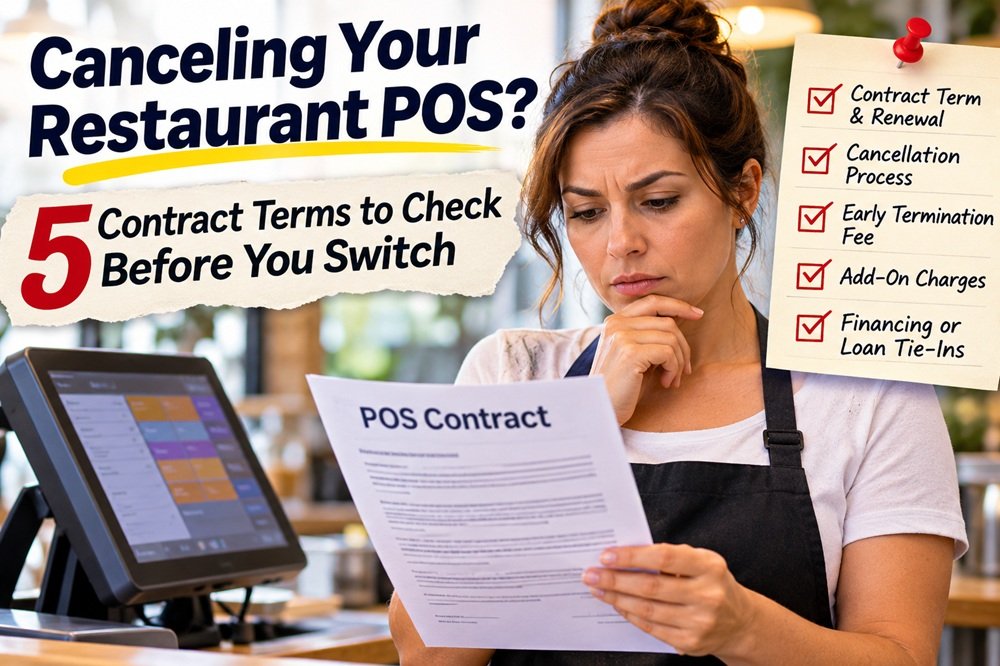
But regardless of how the case is ultimately decided, it highlights five contract terms every small-business owner should check before switching providers.
1. Find the actual contract you signed
Start with the original agreement—not the pricing page you see on the company’s website today.
Look for:
- Contract start and expiration dates
- Whether the term is annual, two-year, or month-to-month
- Automatic renewal provisions
- Cancellation deadlines
- Required method of cancellation
- Early termination fees
This matters because your memory of what the salesperson told you may not match what the contract says.
The FTC alleges that Toast sells POS software through annual or biennial subscriptions that are billed monthly and automatically renew.
That distinction is important.
Paying monthly does not necessarily mean you have a month-to-month contract.
You might receive a bill every month while still being committed to a one- or two-year agreement.
SavingQueen Tip
Save a PDF of your signed agreement as soon as you enter any important business subscription.
Don’t depend on being able to find it in the provider’s online portal years later.
2. Check exactly how cancellation must be submitted
Finding a “Cancel” button isn’t always enough.
Your agreement might require written notice a certain number of days before renewal.
In its complaint, the FTC alleges that Toast customers had to provide 30 days’ written notice of their “intent not to renew” and that this requirement was not clearly disclosed during enrollment.
The government also alleges that some customers who attempted to cancel were directed among customer service, live chat, and other teams.
Before canceling any business service, therefore, find answers to four questions:
How must I cancel?
Where must I send the notice?
How many days before renewal must I send it?
What proof will I have that the company received it?
Don’t rely only on a phone conversation.
If possible, keep the email, confirmation number, screenshot, certified-mail receipt, or other written record showing when you requested cancellation.
3. Calculate the early termination fee before switching
This can be the expensive surprise.
According to the FTC’s complaint, Toast customers seeking to cancel could face an allegedly undisclosed early termination fee calculated at $150 for every remaining month of the contract.
The FTC cites one customer complaint involving a $5,318.87 early termination fee after the customer canceled an account.
Again, these are allegations in an ongoing lawsuit, not a court determination.
But the broader lesson applies to many business contracts.
Before switching providers, don’t ask only:
“How much will the new system save me every month?”
Calculate:
Current contract exit cost + new equipment + installation + setup/training + new monthly cost
Suppose a new POS system would save your restaurant $200 per month.
That sounds like $2,400 in annual savings.
But if leaving the existing contract costs $3,000, switching immediately may not actually save money during the first year.
Sometimes the better financial decision is to negotiate, wait until the current term is closer to expiration, or schedule the transition around the renewal date.
4. Audit every add-on on your monthly statement
POS systems today often do much more than process payments.
A restaurant might also pay for:
- Payroll
- Employee timekeeping
- Online ordering
- Delivery integration
- Inventory management
- Marketing tools
- Accounting services
- Loyalty programs
That convenience can also make the monthly bill difficult to audit.
The FTC alleges that some Toast customers were enrolled in and charged for subscription add-ons without their consent. It also alleges other fees were not adequately disclosed.
This makes a monthly subscription audit worthwhile even if you have no plans to cancel.
Take your current invoice and compare every recurring charge with the products and services you actually use.
For each line, ask:
Did I authorize this?
Do I still use it?
Is this included in my original package or an additional service?
Can I remove it without changing the rest of my contract?
A $25 or $50 add-on may not look significant on one statement.
But recurring charges deserve to be evaluated annually, not ignored simply because they are automatically billed.
5. Check whether financing is tied to the service
This may be the most important lesson from the Toast case.
Toast also offers financing products known as Toast Capital loans to eligible customers.
The FTC alleges that when certain customers with outstanding Toast Capital balances canceled their subscriptions or changed providers, Toast treated the action as a loan default and required the outstanding loan amount to be paid immediately.
The government argues that this could make leaving the service considerably more expensive.
Whether or not you use Toast, the principle is important:
Never assume your software subscription, payment processing agreement, equipment financing, and business loan are completely separate contracts.
Before switching providers, ask:
- Do I have an outstanding equipment balance?
- Is there a business loan connected to this platform?
- Does changing payment processors trigger repayment?
- Does cancellation change the financing terms?
- Is there a personal guarantee?
A cheaper new POS system may not be cheaper if switching suddenly makes thousands of dollars in financing due.
Before You Cancel: The 10-Minute Contract Check
Before changing a POS system, payment processor, payroll platform, or other major business subscription, pull out your contract and answer these five questions:
- When does my current contract expire or renew?
- How and when must I give cancellation notice?
- What is my total early termination cost?
- Which recurring add-ons am I currently paying for?
- Is any loan, equipment financing, or other obligation tied to the service?
Then save copies of the contract, recent invoices, cancellation request, emails, chats, and confirmation numbers.
Those few minutes can make it much easier to understand the real cost of switching.
The Bottom Line
The FTC’s lawsuit against Toast isn’t a reason to assume every Toast contract—or every POS provider—is problematic.
The case has not been decided, and Toast has not been found liable for the allegations simply because a complaint was filed.
The useful lesson is broader.
The best time to understand a cancellation clause is before you need to cancel.
For restaurant owners and other small businesses, a POS system is no longer just a cash register. It may combine software, payment processing, payroll, hardware, subscriptions, and financing into one business relationship.
Before you switch, don’t compare only monthly prices.
Compare the total cost of leaving.
That number may tell you whether switching today really saves money—or whether waiting, negotiating, or changing your timing is the smarter move.
This article is for general informational purposes and is not legal or financial advice. Contract terms and applicable laws vary. The FTC case discussed above is pending, and the allegations have not been finally adjudicated.