
You buy a coffee maker, a child’s toy, a rechargeable battery, or a new car seat. You bring it home, use it regularly, and eventually stop thinking about it.
Months or even years later, the manufacturer discovers a safety problem.
Would you know?
Most of us assume that if something we own becomes dangerous, the manufacturer or retailer will contact us.
Sometimes that happens. But recall notices can be missed, emails can go unopened, and products purchased secondhand may never be connected to our contact information.
The good news is that the U.S. government provides free, publicly accessible tools to help consumers check whether their products have been recalled.
You don’t need to subscribe to a paid service, hire someone to search for you, or wait until an accident happens.
In this guide, we’ll explain where to find official recall information, how to identify affected products, what to do when something you own is recalled, and how to avoid fake refund messages.
It’s a simple consumer protection habit that can help keep your family safe while protecting the money you’ve already spent.
1. What Is a Product Recall, and Why Does It Matter?
A product recall generally occurs when a manufacturer or other responsible company takes action to address a product that may be unsafe, defective, or in violation of applicable requirements.
The problem could involve:
- A household appliance that overheats or catches fire.
- A children’s toy containing a choking hazard.
- Food potentially contaminated with harmful bacteria.
- A vehicle component that may fail.
- A medication with a quality or labeling problem.
- A medical device that requires correction or additional safety instructions.
Some hazards are obvious. Others may not be detectable during ordinary use.
A product can look perfectly normal, operate as expected, and still be subject to a recall.
Importantly, a recall does not always mean the same thing for every product.
Some consumer products must be taken out of use immediately. Others can be repaired or replaced. Certain medical-device recalls involve updated instructions or corrections rather than immediate discontinuation.
The safest approach is to follow the specific instructions issued by the responsible authority and manufacturer.
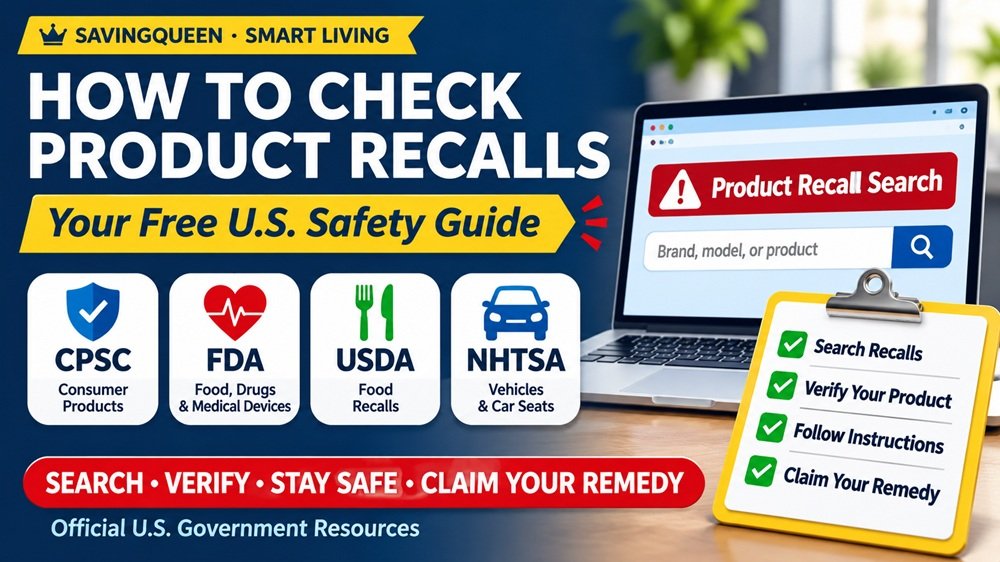
2. Where Should You Check for Product Recalls?
The United States has several agencies responsible for different categories of products.
Knowing which agency covers your purchase is the first step.
| Product category | Official agency or website | What to check |
|---|---|---|
| Toys, appliances, furniture, and many household products | CPSC | Recall notices and safety warnings |
| Food and dietary supplements | FDA / USDA | Product recalls, contamination alerts |
| Prescription drugs and medical devices | FDA | Recall notices and medical safety information |
| Cars, tires, child car seats, and vehicle equipment | NHTSA | Safety recalls and repair information |
| Multiple federal product categories | Recalls.gov | Links to relevant federal recall resources |
These sites are free to use.
CPSC: Everyday household products
Official website: https://www.cpsc.gov/Recalls
The U.S. Consumer Product Safety Commission covers a wide range of consumer products, including many toys, household appliances, furniture, recreational products, and children’s items.
CPSC publishes recall announcements and product safety warnings.
Each recall notice typically includes product photographs, identifying information, the reason for the recall, the remedy, and manufacturer contact details.
If you’re checking a stroller, dresser, space heater, toy, or other general household product, CPSC is usually a useful starting point.
FDA: Food, medicine, and medical devices
Official website: https://www.fda.gov/safety/recalls-market-withdrawals-safety-alerts
The Food and Drug Administration provides recall announcements and safety information for products under its jurisdiction.
These include many food products, medications, medical devices, cosmetics, and dietary supplements.
Some FDA-regulated products may also be listed in the agency’s Enforcement Reports or specialized recall databases.
For medications or medical devices that are essential to treatment, do not independently discontinue treatment simply because you see a headline. Read the specific FDA instructions and contact your pharmacist or healthcare provider when appropriate.
USDA and FoodSafety.gov: Food recall information
Official website: https://www.foodsafety.gov/recalls-and-outbreaks
FoodSafety.gov brings together information about food recalls, public health alerts, and foodborne illness outbreaks.
The FDA generally oversees many foods, while USDA’s Food Safety and Inspection Service handles recalls involving meat, poultry, and certain egg products.
If you hear about a possible food contamination problem, this website is a convenient starting point.
NHTSA: Vehicle and car seat recalls
Official website: https://www.nhtsa.gov/recalls
The National Highway Traffic Safety Administration provides recall information for vehicles, tires, car seats, and certain vehicle equipment.
For cars, you can search by Vehicle Identification Number (VIN) or other available vehicle information.
The VIN search helps identify unrepaired safety recalls associated with a specific vehicle.
However, not every older recall or every type of equipment will necessarily appear in a vehicle-specific VIN result. Use the broader search options when needed.
Recalls.gov: A federal starting point
Official website: https://www.recalls.gov
Not sure which agency regulates your product?
Recalls.gov connects consumers with federal recall information covering multiple product categories.
It’s a useful bookmark when you want to find the correct agency without guessing.
3. How to Search for a Recall on CPSC.gov
Let’s imagine you purchased a rechargeable household appliance several years ago.
You recently heard that some models from the same manufacturer were recalled.
Instead of searching through random social media posts, here’s how to check.
Step 1: Visit the official website.
Go directly to https://www.cpsc.gov/Recalls.
Step 2: Search for the product.
Enter the brand name, product name, manufacturer, model number, or another identifying term.
Step 3: Open the relevant recall notice.
Read the full announcement rather than relying on the headline.
Step 4: Compare the product details.
Check the photographs, model number, serial number, manufacturing date, and other identifying information.
Step 5: Read the remedy instructions.
The notice should explain whether the company is offering a refund, repair, replacement, or another corrective action.
Step 6: Contact the recall administrator.
Use the telephone number, website, or email address listed in the official announcement.
The important lesson is that a brand name alone may not be enough to establish whether your particular item is affected.
4. How Do You Know Whether Your Product Is Actually Recalled?
This is one of the most important parts of the process.
A recall might apply to only certain production dates, batches, sizes, or models.
Two products may look identical but have different manufacturing dates.
One may be recalled while the other is not.
Look for these identifiers.
| Identifier | Where to look |
|---|---|
| Brand and product name | Packaging or product label |
| Model number | Manufacturer’s label, underside, back panel |
| Serial number | Product label or device settings |
| SKU or UPC | Packaging, product listing, purchase record |
| Lot or batch number | Food packaging, product label |
| Manufacturing date | Label, tag, or serial information |
| VIN | Vehicle dashboard, driver’s door area, registration |
For example, a food recall may involve only a specific lot number or expiration date.
A bicycle helmet recall might apply to one model and size.
A vehicle recall may affect certain vehicles built during a specified manufacturing period.
Don’t assume every product from a particular brand is recalled.
Conversely, don’t assume a product is safe simply because it looks different from a photograph you saw in an online article.
Always compare the official identification details.
5. What Should You Do If You Own a Recalled Product?
The first step depends on the nature of the hazard and the recall instructions.
For a household product with an immediate fire, choking, or injury hazard, the notice may direct consumers to stop using it immediately and keep it away from children.
For a food product subject to a contamination recall, the instructions may tell you not to eat it and explain how to return or discard it.
For a recalled medication or essential medical device, the appropriate action may involve contacting a healthcare professional and following treatment-specific directions.
For a vehicle, the manufacturer may provide interim safety guidance while a repair is arranged.
A useful general process is:
- Confirm that your product matches the official recall.
- Follow the safety instructions immediately.
- Save identifying information and proof of purchase if available.
- Contact the official recall administrator.
- Complete the required remedy process.
- Retain confirmation that the issue was resolved.
Don’t repair or modify a recalled product yourself unless the approved remedy specifically instructs you to do so.
And don’t donate or resell unsafe recalled products.
6. Refund, Repair, or Replacement: What’s the Difference?
One common misunderstanding is that every product recall guarantees a cash refund.
That is not the case.
Different recall programs offer different remedies.
| Remedy | What it means | What consumers should know |
|---|---|---|
| Refund | Money or another specified form of compensation | May be full, partial, or in the form of a gift card |
| Repair | The company fixes the identified problem | May involve a repair kit or authorized service |
| Replacement | The affected product is exchanged | The replacement should address the recall issue |
| Updated instructions | New directions or other corrective steps | Follow the specific notice carefully |
| Disposal | Product must be safely discarded | Special handling may be required |
Sometimes a manufacturer may ask you to mark a product “RECALLED,” cut a specified part, or submit photographs before receiving compensation.
Follow those instructions only after verifying that they come from the official recall notice.
For batteries, electronics, and other products involving hazardous materials, ordinary trash disposal may not be appropriate.
Check the official instructions and local disposal requirements before discarding the item.
What if you no longer have the receipt?
Don’t automatically assume you’re ineligible.
Some recall programs can verify products through a serial number, model identifier, photograph, or purchase record.
Others may require additional documentation.
Check the specific recall notice and contact the administrator.
What if you bought the product secondhand?
A recalled item remains a potential safety concern regardless of where you purchased it.
Contact the recall administrator to find out whether the remedy is available to you.
Eligibility and documentation requirements can vary.
7. How to Check Vehicle Recalls Using Your VIN
Your car is one of the most valuable purchases you may own.
And a vehicle safety recall can involve something much more serious than an inconvenience.
Examples include airbag components, braking systems, steering mechanisms, electrical systems, or other safety-related equipment.
Fortunately, checking a vehicle is relatively straightforward.
Find your VIN
A VIN is a unique 17-character vehicle identification number used on most modern vehicles.
You can usually find it:
- Near the driver’s side of the dashboard, visible through the windshield.
- On a label near the driver’s door.
- On your vehicle registration.
- On certain insurance documents.
Search NHTSA
Visit https://www.nhtsa.gov/recalls and enter the VIN in the appropriate search field.
Review any open safety recall results and the manufacturer’s instructions.
If a recall applies, contact an authorized dealership or the manufacturer to arrange the remedy.
Safety recall repairs are generally provided without charge under applicable NHTSA requirements, although certain limitations and exceptions may apply.
If you receive a vehicle recall notice, don’t ignore it just because your car appears to be operating normally.
8. How to Check Food Recalls Before Eating Something
Food recalls can be especially confusing because they may involve only a small portion of products sold under the same brand.
Imagine opening your refrigerator and discovering that a particular packaged food was recalled.
Before throwing away every product from that company, verify the specific details.
Check the brand, product name, size, lot number, expiration date, and applicable distribution information.
If your food matches the recall, follow the official instructions.
A contaminated product may also affect surrounding surfaces.
For example, food contaminated with harmful bacteria can create additional risks through spilled contents or cross-contamination.
Clean affected storage areas according to the official food safety guidance.
Do not taste a potentially recalled product to determine whether it is safe.
Harmful bacteria and undeclared allergens cannot reliably be detected by appearance, smell, or taste.
9. Beware of Fake Recall and Refund Messages
Here’s a situation worth recognizing.
You receive a text message:
“Important Product Recall: You qualify for a $125 refund. Click here to claim your money.”
The message contains a link to a website asking for your name, address, credit card number, and a small processing fee.
It looks official.
But is it?
Scammers can use the language of legitimate product recalls to collect personal information or financial details.
The Federal Trade Commission has warned about fraudulent messages offering refunds for purchases.
How to protect yourself
Don’t click unfamiliar links. Instead, visit the official agency or retailer website directly.
Verify the recall number and product details. A legitimate recall notice should provide identifying information.
Be suspicious of unexpected processing fees. Don’t pay a third-party service simply because it promises to release your refund.
Protect your personal information. Don’t enter payment-card or banking information into an unfamiliar website.
Contact the company independently. Use the contact details published in the official recall announcement.
If you encounter a suspected scam, report it through https://reportfraud.ftc.gov.
Remember that an actual recall may require personal information to process a legitimate remedy. The point is to verify the recipient and the official process before providing it.
10. How to Receive Recall Alerts Automatically
You don’t have to search every government website every morning.
Several agencies offer ways to receive recall and safety information.
Subscribe to CPSC alerts
Visit:
CPSC offers email notifications about recalls and product safety matters.
Depending on available subscription options, you can select relevant interests.
Subscribe to FDA notifications
Visit the FDA’s recall resources and locate its email subscription options.
FDA offers notification services for recall information, including daily or weekly updates.
Keep your vehicle information current
NHTSA recommends registering vehicles and relevant equipment, as well as checking for recalls periodically.
Keep your vehicle registration and manufacturer contact information up to date so important notices are less likely to be missed.
Register major products
For products that offer manufacturer registration, consider completing it—especially when it helps the manufacturer contact you about safety issues.
Registration may improve notification, but it does not replace checking official recall databases.
11. A Simple 10-Minute Household Recall Check
You don’t need to turn product safety into a complicated monthly project.
Instead, build a routine that fits your household.
Here’s a simple example.
| Time | Task |
|---|---|
| 2 minutes | Check CPSC for relevant household products |
| 2 minutes | Review current FDA/USDA food safety alerts |
| 2 minutes | Review one category of older purchases |
| 2 minutes | Check vehicle recall status when appropriate |
| 2 minutes | Save any relevant recall instructions |
You don’t need to check every product from scratch every month.
Focus on what your household actually owns.
If you have young children, prioritize toys, nursery products, and children’s equipment.
If you care for an older adult, pay attention to mobility aids and other household safety devices.
If you use rechargeable batteries or electrical products frequently, review those categories periodically.
The objective isn’t to become anxious about every purchase.
It’s to develop a reasonable habit of checking reliable information before a small problem becomes a larger one.
12. What If You Discover a Dangerous Product That Hasn’t Been Recalled?
Not every unsafe product has already been identified by regulators.
Sometimes the first warning comes from consumers who experience a problem.
If you discover a potentially dangerous household product, document what happened.
Record the brand, model number, purchase information, photographs, and any relevant circumstances.
You can report eligible consumer product safety concerns through:
For products regulated by the FDA, use the appropriate FDA safety reporting channel.
For suspected vehicle defects, NHTSA also accepts safety complaints.
Consumer reports can help regulators identify potential hazards that might otherwise remain unnoticed.
Reporting a problem does not automatically trigger a recall, but it can contribute to broader safety investigations.
13. Save or Skip: Is a Recall Worth the Trouble?
Consider a household that discovers a recalled product originally purchased for $45.
The manufacturer offers a full refund.
The consumer must complete a registration form, submit a photograph, and follow the required disposal instructions.
Let’s look at the financial side.
| Item | Illustrative value |
|---|---|
| Original purchase price | $45 |
| Available refund | $45 |
| Out-of-pocket claim fee | $0, assuming none is required |
| Potential amount recovered | $45 |
The actual refund and requirements depend on the recall program.
You shouldn’t assume that every recall offers $45, a full refund, or no incidental expenses.
But a legitimate remedy may help recover money from a product you can no longer safely use.
SavingQueen’s Save or Skip verdict
SAVE: Purchase records, model numbers, original receipts, and verified recall instructions.
SKIP: Continuing to use recalled products simply because they still appear functional.
CLAIM: Legitimate refunds, repairs, or replacements through the official process.
AVOID: Paying questionable third parties or following unverified recall messages.
And remember that the most important benefit of a recall is not always financial.
Preventing a serious injury can be worth far more than recovering the purchase price.
14. Your Personal Product Safety Checklist
Before your next major purchase—or the next time you organize your home—ask yourself:
- Do I know where to check for recalls involving this product?
- Have I kept the model number and purchase details?
- Is the manufacturer able to contact me about safety updates?
- Have I checked whether any older products in my home were recalled?
- Do I know how to distinguish official recall notices from scams?
You don’t need perfect records for every item you own.
Start with expensive products, products used by children, and equipment where a failure could cause serious harm.
A little organization now can make it easier to respond quickly if something goes wrong later.
The Bottom Line: A Smarter Way to Protect Your Purchases
Saving money isn’t only about finding discounts, earning rewards, or comparing prices.
It also means protecting the value of the things you’ve already purchased.
A product recall can be frustrating, especially when you have to replace something you thought would last for years.
But the U.S. government provides free tools that can make the process easier.
You can search for recalls, verify whether your product is affected, find official instructions, and request an available remedy.
The most useful approach is not to follow every recall announcement in the news.
It’s to know where to look when you need reliable information.
Bookmark the official websites, keep important product details accessible, and make recall checks part of your normal household routine.
Smart shopping doesn’t end at checkout. It includes knowing how to protect your purchases—and the people who use them.
Frequently Asked Questions
What is the best website to check product recalls?
For general household products, CPSC.gov/Recalls is a useful starting point. Recalls.gov provides links to multiple federal recall resources. FDA, USDA, and NHTSA cover additional product categories.
Is checking recalls free?
Yes. The official U.S. government recall resources described in this guide are free to access.
Does every recalled product qualify for a refund?
No. The remedy may be a refund, repair, replacement, updated instructions, or another corrective action.
Can I check recalls without a receipt?
Yes. You can search recall databases without a receipt. Whether you need documentation to receive a remedy depends on the particular recall program.
How do I check whether my car has an open recall?
Visit NHTSA.gov/recalls and search using your vehicle identification number or other available search options.
Can I keep using a recalled product if it still works?
Do not assume continued use is safe. Follow the official safety directions. Some recalled products require immediate discontinuation, while other cases involve specific repairs, corrections, or medical guidance.
Do product recalls expire?
Recall remedy availability and legal requirements vary. Some recalls remain active for many years, while particular remedies may change. Check the current official recall notice and contact the administrator.
Are product recall emails always legitimate?
No. Scammers can impersonate retailers or government agencies. Verify messages through official websites before following instructions or sharing personal information.
Should I throw away a recalled product immediately?
Follow the official recall directions first. Some programs require photographs or product identification before disposal. Batteries, chemicals, and other hazardous products may require special handling.
Official U.S. Recall Resources
Consumer products: U.S. Consumer Product Safety Commission
Food recalls and outbreaks: FoodSafety.gov
FDA recalls and safety alerts: U.S. Food and Drug Administration
Vehicles and car seats: National Highway Traffic Safety Administration
Federal recall directory: Recalls.gov
CPSC recall email alerts: Subscribe to CPSC Updates
Report unsafe consumer products: SaferProducts.gov
Report suspicious refund messages: FTC ReportFraud
Last reviewed: November 24, 2026. This article provides general consumer safety and financial education. Recall details, remedies, and government resources may change. Always consult the relevant official notice for product-specific instructions.