
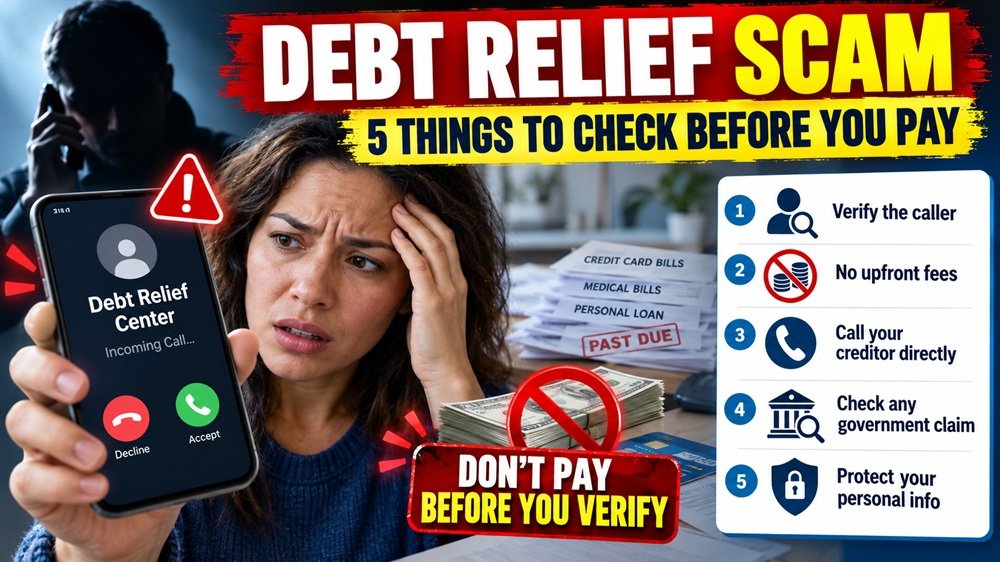
Your phone rings, and the person on the other end seems to know a surprising amount about you.
They know you have credit-card debt. They may even know your bank’s name, your approximate balance, your ZIP code, or part of your Social Security number.
Then comes the offer: “We can reduce what you owe,” “We have a special debt-relief program,” or “Your bank has authorized us to settle your account.”
Before you pay anything, stop.
Knowing information about your account does not prove the caller works for your bank, credit-card company, or a government agency.
A recent Federal Trade Commission case shows how convincing these schemes can become. In October 2026, a federal court permanently banned operators of a debt-relief operation after the FTC alleged that the businesses impersonated banks, credit-card companies, and government agencies while promising consumers large reductions in their debts.
The most useful lesson is not the name of that particular company. It is knowing what to check when someone offers to make your debt disappear.
Check #1: Hang up and contact your creditor yourself
If someone unexpectedly says they represent your bank or credit-card company, do not verify the claim using a phone number they give you.
Instead, end the conversation and contact the creditor independently.
Use:
- The phone number printed on the back of your credit card
- The number shown on your monthly statement
- The official bank or card-company app
- The creditor’s website that you normally use
Ask whether the company actually contacted you or authorized the debt-relief offer.
This simple step matters because caller ID is not reliable proof of identity. Scammers can make a call appear to come from a familiar company or local number.
And don’t assume the caller must be legitimate because they know your balance or other personal information. FTC consumer guidance warns that scammers sometimes already have pieces of personal or financial information and use those details to gain your trust.
Check #2: Are they asking you to pay before anything has happened?
An upfront fee is one of the strongest warning signs.
FTC rules prohibit for-profit companies selling debt-relief services by telephone from collecting fees before they have actually settled, reduced, or otherwise changed the terms of at least one debt under the applicable requirements.
In practical terms, be extremely cautious if someone says:
- “Pay the enrollment fee first.”
- “We need $500 before we contact your creditors.”
- “Send the processing fee today to lock in the program.”
- “Pay us now and we’ll reduce your credit-card balance later.”
A legitimate debt solution should not begin with pressure to send money immediately for a promised future result.
Also be skeptical of guarantees such as:
“We’ll eliminate 75% of your debt.”
“Everyone qualifies.”
“Your debt is guaranteed to disappear.”
No company can honestly guarantee how every creditor will respond before reviewing your actual financial situation.
Check #3: Are they telling you to stop paying your real creditor?
This is where a debt-relief offer can become particularly expensive.
A caller may tell you to stop making payments to your credit-card company and send money to the debt-relief program instead.
Do not make that change solely because an unsolicited caller told you to.
If payments to your real creditor stop, several things can happen while you’re waiting for a promised settlement:
- Late fees may accumulate
- Interest may continue to accrue
- Your account can become more delinquent
- Your credit may be damaged
- The creditor may pursue collection
If you’re struggling to make payments, contact the creditor directly first.
Explain your situation and ask whether the company offers a hardship program, lower payment, reduced interest rate, temporary payment arrangement, or another option.
You may discover that the creditor is willing to work with you without requiring you to pay a third party.
Check #4: Are they claiming to have a special government program?
Words such as “federal,” “government-approved,” “relief program,” “forgiveness,” or “special program” can make an offer sound official.
That doesn’t make it real.
FTC enforcement actions have repeatedly involved companies accused of using government-style names or falsely suggesting ties to trusted institutions.
If someone says you qualify for a government debt-relief program, ask:
- What is the exact name of the program?
- Which federal or state agency runs it?
- Can you independently find it on an official government website?
- Does the agency itself say this private company is authorized to enroll you?
Don’t use a website or phone number supplied by the salesperson as your only verification.
Search for the government agency independently and look for an official .gov source.
And remember: a company name that sounds governmental does not make it a government agency.
Check #5: Are they rushing you to share information or send money?
Pressure is another major red flag.
A scammer may tell you:
- “This offer expires today.”
- “You must enroll during this call.”
- “Don’t contact your credit-card company.”
- “Give us your bank account information so we can secure your spot.”
An unexpected caller should not need your Social Security number, online banking password, one-time security code, or complete bank-account credentials just to explain a debt-relief offer.
FTC guidance says not to share personal or financial information with someone who contacts you unexpectedly offering debt relief.
If the offer is legitimate, you should have time to investigate the company, read the agreement, understand the fees, and independently verify what will happen to your existing debts.
What if the caller really does know your credit-card balance?
This can be one of the most convincing parts of the scam.
Suppose someone calls and says:
“We see that you currently owe about $18,000 on your credit cards. We can reduce that to $7,000.”
Your first reaction may be, “How could they know that unless they’re working with my bank?”
But information can come from many places, including data breaches, marketing databases, compromised accounts, credit information obtained improperly, or information collected from previous contacts.
The fact that someone knows something about you proves only that they have information—not that they are who they claim to be.
Debt settlement and credit counseling are not the same thing
It also helps to understand what kind of service you’re being offered.
Debt settlement generally involves trying to negotiate with creditors so they accept less than the full amount owed. Results are not guaranteed, and stopping payments during the process can have financial consequences.
Credit counseling usually starts with reviewing your income, expenses, debts, and budget. A counselor may help you create a repayment strategy or, where appropriate, a debt management plan.
FTC guidance says a reputable credit counseling organization should be willing to provide information about its services before requiring you to reveal extensive details about your financial situation.
Possible places to look for lower-cost counseling resources can include credit unions, universities, community colleges, and—for servicemembers—military personal financial managers.
Before enrolling anywhere, ask exactly what the service costs.
If you’re already behind, start by calling the company you owe
You don’t need to wait for a debt-relief advertisement to take action.
If you’re having difficulty making credit-card payments, contacting the lender early can be more useful than waiting until the account reaches collections.
You can ask:
- Do you have a hardship program?
- Can my monthly payment be temporarily reduced?
- Is a lower interest rate available?
- Can the due date be changed?
- Are there payment-plan options?
Not every creditor will offer every option, and approval is not guaranteed. But contacting the lender directly helps you understand your real choices before paying a third party.
What if you already paid the debt-relief company?
Act quickly if you now believe the payment was part of a scam.
The FTC recommends contacting the company you used to send the money and asking whether the transaction can be stopped or reversed.
For example:
- Credit or debit card: Contact the card issuer or bank immediately and report the fraudulent payment.
- Bank transfer: Contact your bank or credit union immediately and ask whether the transfer can be reversed.
- Payment app: Report the transaction to the app provider and ask whether it can be reversed.
- Wire transfer: Contact the bank or wire-transfer company immediately.
- Gift card: Contact the card issuer immediately and keep the card and receipt.
Recovery is not guaranteed, but waiting generally does not improve your chances.
You can also report a suspected debt-relief scam to the FTC at ReportFraud.ftc.gov.
Why this issue is back in the news
On October 14, 2026, a federal court entered a $106.8 million default judgment against seven corporate defendants connected to the Accelerated Debt Settlement case.
The FTC says the operation targeted consumers, including seniors and Veterans, and alleged that its operators impersonated banks, credit-card companies, and government agencies while promising substantial debt reductions and collecting illegal advance fees.
The October court orders permanently bar the defendants involved from the debt-relief industry.
That judgment should not be interpreted as a guarantee that affected consumers will automatically receive refunds. The FTC has said that assets collected from certain individual defendants can become available for consumer redress, but specific refund eligibility and payment amounts are separate questions.
The SavingQueen 5-check rule
When an unexpected debt-relief offer arrives, remember this sequence:
1. Verify the caller yourself.
Hang up and call the number on the back of your card.
2. Don’t pay upfront for a promised result.
Advance-fee demands are a major warning sign.
3. Don’t stop paying your creditor because a caller tells you to.
Ask the creditor directly about hardship options first.
4. Verify every “government program” independently.
Look for an actual government agency and official .gov information.
5. Never let urgency replace verification.
Protect your SSN, account information, passwords, and security codes.
The SavingQueen takeaway
Debt problems can make an offer to cut a balance by 50%, 70%, or even more sound irresistible.
That is exactly why this type of scam works.
The safest response to an unexpected debt-relief pitch is not to decide whether the offer sounds convincing. It is to verify the offer through a source the caller does not control.
If someone says they represent your bank, call your bank yourself.
If they mention a government program, find the government agency yourself.
If they demand money before producing results, stop.
And if you’re genuinely struggling with debt, begin with your actual creditor or a reputable counseling resource rather than an unsolicited salesperson promising a shortcut.
FTC enforcement update: October 22, 2026
Corporate court order: October 14, 2026
Corporate judgment: $106.8 million default judgment
Consumer warning: Be cautious of advance fees, guarantees, impersonation, and unsolicited requests for financial information
Fraud reporting: ReportFraud.ftc.gov