
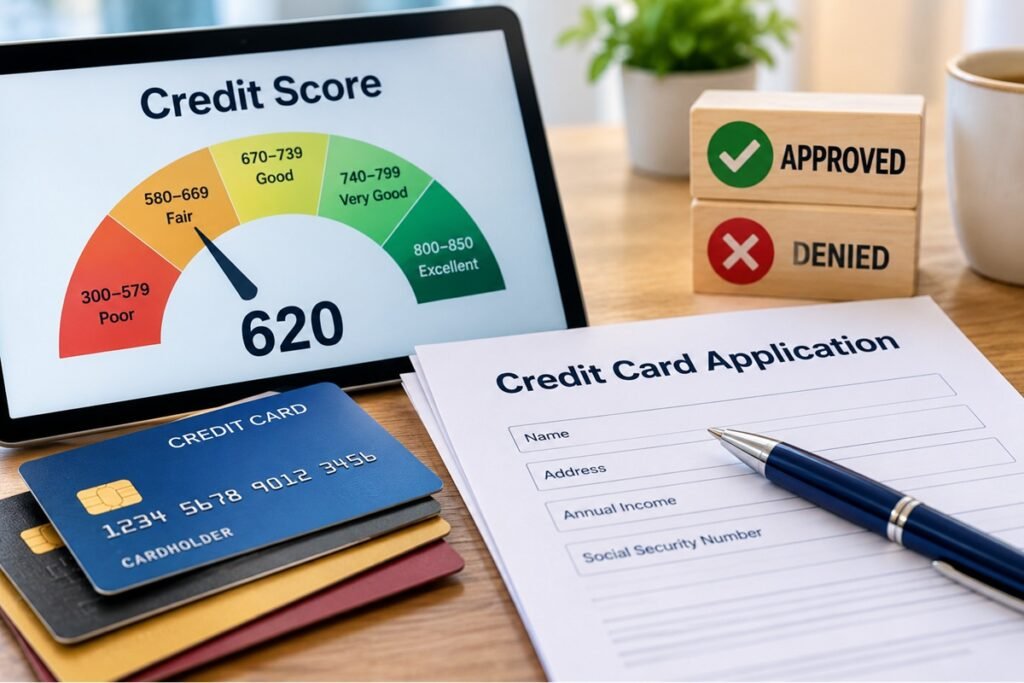
If your credit score is less than perfect, recent headlines about tighter lending may make it sound as though credit-card companies are shutting the door on lower-score applicants.
The latest data tell a more complicated story.
Large banks are still operating with relatively tight credit-card standards, especially for riskier borrowers, but they have not broadly stopped lending to people with lower credit scores. In fact, recent large-bank data show that borrowers with scores below 660 are receiving a larger share of newly opened credit-card accounts than they were a year earlier.[1]
The catch is that lenders appear to be controlling their risk in other ways—particularly by keeping credit lines much smaller for lower-score borrowers.
So if you are deciding whether to apply for a card, the useful question is not simply, “Are banks tightening?” It is: What does the current market mean for my chances of approval, the credit limit I might receive, and whether applying is worth a hard inquiry?
Are Credit Card Lenders Actually Pulling Back?
Not across the board.
The Federal Reserve Bank of Philadelphia’s latest Large Bank Credit Card and Mortgage Data show that consumers with credit scores below 660 accounted for 18.5% of newly originated credit-card accounts in the second quarter of 2026, up from 16.1% in the second quarter of 2025.[1]
The number of new credit-card accounts at the large banks in the dataset also increased by nearly 4% from a year earlier.
That is not what a broad retreat from lower-score borrowers would look like.
But it does not mean lending standards are loose.
In the Federal Reserve’s July 2026 Senior Loan Officer Opinion Survey, a modest net share of banks said they had tightened standards on credit-card loans during the second quarter. More importantly, when banks compared today’s standards with their own historical ranges since 2005, a major net share said standards for subprime credit cards were toward the tighter end of those ranges.[2]
The best description is therefore cautious expansion: more lower-score borrowers are receiving cards, while banks continue to limit the amount of risk they take on.
The Credit Limit Tells an Important Part of the Story
The difference becomes much clearer when you look at the size of new credit lines.
Among the large banks tracked by the Philadelphia Fed, the median credit limit on a newly originated account in the second quarter of 2026 was:
| Credit Score Group | Median New Credit Limit |
|---|---|
| Below 660 | $600 |
| 660 to 719 | $2,700 |
| 720 and above | $7,000 |
The lowest-score group’s median limit actually improved from $500 a year earlier to $600.[1]
But a $600 median line is still dramatically smaller than the $7,000 median for borrowers in the highest score group.
That distinction matters.
A lender does not have only two choices—approve you or reject you. It can also approve an account while limiting its exposure with a smaller credit line.
The Consumer Financial Protection Bureau notes that issuers generally consider information such as your credit report and history, balances on other cards, and income when deciding how much credit to extend.[3]
Why “Subprime” Can Be a Confusing Label
Be careful when comparing statistics from different reports.
There is no single score boundary used in every credit-card dataset.
For example, the CFPB’s current Consumer Credit Trends data divide FICO Score 8 borrowers into five groups:[4]
- Deep subprime: below 580
- Subprime: 580–619
- Near-prime: 620–659
- Prime: 660–719
- Super-prime: 720 and above
The Philadelphia Fed report groups borrowers with scores below 660 together for part of its analysis.
The Federal Reserve’s Senior Loan Officer Opinion Survey is different again: banks use their own classifications of prime and subprime borrowers rather than one required credit-score cutoff.[1]
So a headline saying “subprime lending increased” does not automatically mean someone with a 575 score has the same approval prospects as someone with a 650 score.
What the CFPB Data Can—and Cannot—Tell Us Yet
The CFPB updated its credit-card borrower-risk data in October 2026. The latest observations currently extend through March 2026 and divide new credit-card activity by FICO Score 8 risk group.[4]
There is an important limitation, however: the CFPB says the most recent six months of observations are not final.
That makes the dataset useful for watching the direction of credit markets, but it would be unwise to treat the latest month’s figures as a permanent trend or as a prediction of one person’s approval odds.
The Philadelphia Fed’s second-quarter data provide a clearer current signal for large banks: lower-score borrowers gained origination share, but the amount of credit extended to them remained modest.[1]
Other Data Also Point Away From a Blanket Credit Pullback
Equifax reported a similar pattern earlier in 2026 using its own consumer-credit data.
As of January 2026, Equifax reported that new subprime bankcard accounts were up 18.6% from a year earlier, while total credit limits originated to that group had also risen.[5]
Because Equifax uses its own data and risk definitions, those numbers should not be mixed directly with the Philadelphia Fed or CFPB score bands.
But taken together, the reports make it difficult to support a simple claim that credit-card lenders have stopped serving lower-score consumers.
Why Can Credit Expand While Lending Standards Stay Tight?
“Tight standards” and “more new accounts” sound contradictory, but they measure different things.
A bank can maintain strict approval criteria while still opening more accounts if:
- more applicants meet those criteria;
- the lender expands selected lower-score programs;
- competition encourages banks to seek new customers;
- the lender approves riskier borrowers with smaller limits;
- other information in an applicant’s file offsets a lower credit score.
The Federal Reserve distinguishes between lending standards, which are the policies used to decide whether applications are approved, and lending terms, which determine the conditions attached to approved credit.[2]
A $600 credit line rather than a $7,000 line is one example of how access to credit and the amount of credit offered can tell different stories.
What Does This Mean if Your Credit Score Is Below 660?
It means you should not assume that applying is pointless.
But you also should not interpret rising lower-score originations as evidence that any particular issuer is likely to approve you.
Your credit score is only part of a card issuer’s decision. Issuers can also consider your income, existing debts, credit history, recent applications, and other information allowed under their underwriting policies.
A useful approach is to reduce avoidable uncertainty before submitting a formal application.
A 5-Step Check Before You Apply
1. Check your credit reports first
Look for errors, unfamiliar accounts, incorrect late payments, or balances that have already been paid down.
Checking your own credit report is a soft inquiry and does not hurt your credit score. The CFPB notes that the nationwide credit reporting companies currently make credit reports available weekly upon request.[6]
2. Don’t confuse a marketing offer with guaranteed approval
A prescreened credit-card offer can be a useful signal because the issuer selected consumers using specified credit criteria.
But it is not an unconditional approval.
The CFPB says the card company can still review your updated credit report and other information, including whether you have sufficient income, once you actually apply.[7]
3. Be selective about formal applications
When you actually apply for a credit card, the issuer normally obtains your credit report. That produces a hard inquiry, which may affect your credit score.[6]
Submitting application after application simply to see which issuer says yes can therefore have a cost.
If an issuer provides an eligibility or prequalification tool that clearly states it uses only a soft inquiry, that may help you narrow your choices before making a formal application. Read the issuer’s terms carefully because screening processes vary.
4. Judge the offer by more than approval
An approval is not automatically a good deal.
If your credit profile leads to a small limit, high interest rate, annual fee, or other unfavorable terms, compare the card with lower-cost alternatives before accepting it.
A $500 or $600 limit may still be useful for building payment history or handling controlled spending, but it leaves very little room before your balance becomes a large percentage of the available limit.
5. If you’re denied, read the adverse-action notice
Do not throw the denial letter away.
If a lender rejects your credit application, federal rules generally require it to give you the main reasons for the decision or explain how you can obtain those reasons. If the decision was based on your credit report, the notice also includes information about the credit reporting company and the score used in the decision.[8]
That information is more useful than guessing that your score was simply “too low.”
You may discover that the bigger issue was high existing balances, too many recent inquiries, insufficient credit history, income relative to obligations, or incorrect information in your report.
A Lower Score Does Not Tell the Whole Story
There is also an important difference between a population trend and your individual application.
The fact that borrowers below 660 received 18.5% of newly originated large-bank accounts in one quarter does not mean an applicant with a 640 score has an 18.5% chance of approval.
It means 18.5% of the new accounts observed in that dataset belonged to consumers in that score group.
Those are completely different statistics.
Likewise, the fact that lenders describe their subprime standards as historically tight does not mean every bank has stopped approving applicants with weaker credit.
Credit-card underwriting differs by lender and product.
Should You Wait to Apply Until Your Score Improves?
Sometimes that is the cheaper move.
If you do not urgently need a new credit line and your report contains a correctable problem—such as a reporting error or a high card balance you expect to pay down soon—waiting may improve the range of offers available to you.
But there is no universal score at which waiting suddenly stops making sense.
If you need a card for a practical reason, compare products realistically available to your credit profile and focus on total cost, not status or rewards.
A card with no annual fee and modest benefits may be a better financial tool than stretching for a rewards card whose cost or approval requirements do not fit your situation.
The Bottom Line
Credit-card lenders are being cautious with lower-credit-score borrowers, but the latest evidence does not show a broad retreat from lending to them.
At large banks, consumers with scores below 660 increased their share of new credit-card accounts from 16.1% in the second quarter of 2025 to 18.5% in the second quarter of 2026.[1]
At the same time, banks report that subprime credit-card standards remain toward the tighter end of their historical ranges, and lower-score borrowers receive much smaller credit lines on average than borrowers with stronger scores.[1][2]
For an individual applicant, that means the door is not necessarily closed—but approval may come with a smaller limit or less favorable terms.
Before applying, check your reports, target cards that realistically fit your credit profile, avoid unnecessary hard inquiries, and judge any approval by the cost and terms of the card rather than by the approval itself.
Information verified October 19, 2026. Credit-card approval criteria, credit limits, rates, fees, and scoring models vary by issuer. Market-level data cannot predict whether a particular application will be approved.
[1] The Federal Reserve Bank of Philadelphia’s October 7, 2026 report found that consumers with scores below 660 increased their share of newly originated large-bank card accounts from 16.1% to 18.5%, while the group’s median new credit line increased from $500 to $600. The report describes the pattern as expansion into higher-risk segments combined with caution about how much credit is extended. Federal Reserve Bank of Philadelphia
[2] The Federal Reserve’s July 2026 Senior Loan Officer Opinion Survey found a modest net tightening of credit-card standards during the second quarter. A major net share of banks also reported that their subprime-card standards were at the tighter end of their historical ranges. Federal Reserve