
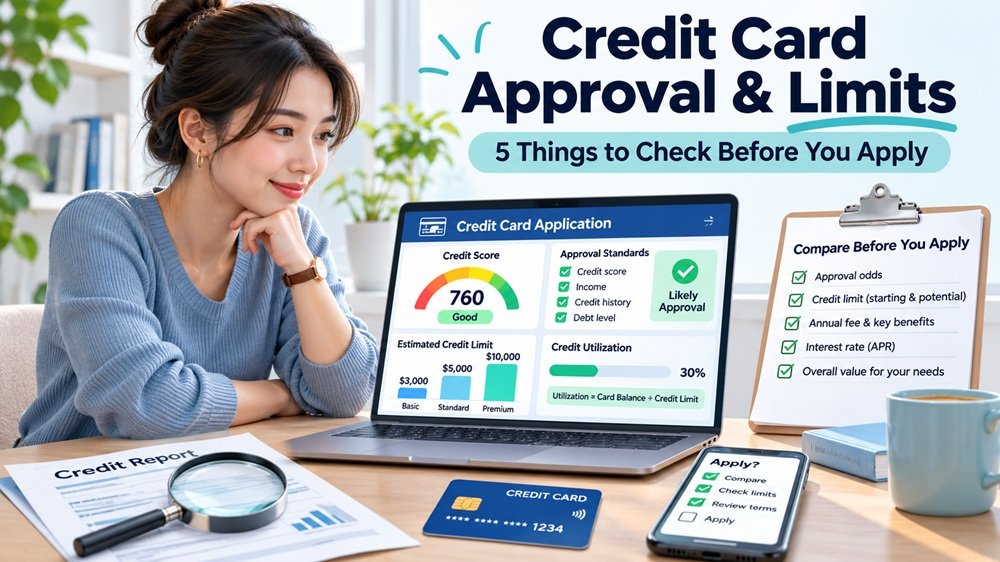
A higher credit score may improve your options, but it does not guarantee approval—or the credit limit you expect. Here’s what changed and what to check before applying.
You check your credit score, see a number you feel good about, and decide it might be time to apply for a new credit card.
But what if the bank offers a smaller limit than expected—or declines the application altogether?
A new Federal Reserve survey helps explain why two applicants can have different experiences even when their credit scores look reasonably strong.
Released on November 2, 2026, the Federal Reserve’s October Senior Loan Officer Opinion Survey found that banks generally kept their consumer lending standards unchanged during the third quarter. However, there were important exceptions involving applicants who did not meet credit-score thresholds and the credit limits banks were willing to provide.
The message for consumers isn’t that credit cards have suddenly become difficult to get.
It’s that your credit profile, the issuer’s standards, and the amount of credit you’re requesting all matter.
What Did the Federal Reserve Actually Find?
The Federal Reserve regularly surveys bank lending officers about their institutions’ lending policies and demand for loans.
The October 2026 survey included responses from 61 domestic banks and 18 U.S. branches and agencies of foreign banks. Its consumer-lending findings primarily summarize the domestic-bank responses.
Three results are especially relevant to credit card users.
1. Most banks did not broadly tighten approval standards
Among the 50 banks responding to the general credit-card approval standards question:
- 92% reported basically unchanged standards.
- 6% reported somewhat tighter standards.
- 2% reported somewhat easier standards.
This matters because a headline saying banks are tightening credit would miss the larger picture.
Most responding banks were not reporting a broad change in their general standards.
2. Some banks became less flexible with certain borrowers
Banks reported tightening, on balance, how frequently they granted credit card loans to applicants who did not meet their credit-scoring thresholds.
In special questions covering the previous year, banks also reported becoming more likely to approve applicants in their prime and super-prime categories, while becoming less likely, on balance, to approve subprime applicants.
Approval likelihood for near-prime borrowers was broadly unchanged.
These are bank-reported changes, not an estimate of any individual’s approval probability.
Also, banks do not all define prime, near-prime, or subprime using identical score ranges.
3. Credit limits became somewhat tighter
Banks also reported modest tightening in credit card limits.
According to the Federal Reserve’s detailed survey tables, about 90% of responding banks left credit-limit policies basically unchanged, while roughly 8% tightened and 2% eased them.
This doesn’t mean your bank is about to lower your limit.
It does mean consumers should pay attention to their available credit—not just their account balances.
Why a Good Credit Score Doesn’t Guarantee Approval
A credit score is an important part of a lending decision, but it isn’t the entire application.
A credit card company may also consider income, existing debt obligations, credit history, recent applications, and its own lending policies.
And there isn’t just one credit score.
The Consumer Financial Protection Bureau (CFPB) explains that lenders use different scoring models and information from different credit reporting companies.
The score you see through a banking app may not be identical to the score a particular lender uses.
Think of your credit score as one important part of your financial profile, not a universal approval ticket.
A high score may make favorable terms more likely, but it doesn’t obligate a lender to approve the card or offer a particular credit limit.
A Smaller Credit Limit Can Change Your Credit Utilization
This is one of the most practical things to understand from the survey.
Credit utilization is the percentage of available revolving credit that you’re using.
The basic calculation is:
Credit Utilization = Credit Card Balance ÷ Credit Limit × 100
Consider a hypothetical consumer with one credit card.
| Before Limit Reduction | After Limit Reduction | |
|---|---|---|
| Card balance | $2,000 | $2,000 |
| Credit limit | $10,000 | $5,000 |
| Credit utilization | 20% | 40% |
Nothing about the balance changed.
The consumer did not spend another dollar.
But because the available credit was reduced, utilization doubled from 20% to 40%.
That could negatively affect the consumer’s credit score, depending on the scoring model and the rest of the credit profile. It does not establish any specific point decrease.
The CFPB notes that credit card issuers generally can reduce account limits and recommends keeping balances relatively low compared with available credit.
A common guideline is to use no more than 30% of total available revolving credit. However, 30% is not a guaranteed safe cutoff or an approval requirement. Lower utilization may be beneficial, and scoring models differ.
The bigger lesson is simple:
Available credit matters, even when your spending doesn’t change.
Five Things to Check Before Applying for a Credit Card
A Federal Reserve survey cannot tell you whether a particular bank will approve your next application.
But it provides a good reason to review a few important details first.
1. Check your credit reports before submitting an application
Start with your actual credit reports rather than relying only on a score displayed in an app.
You can review your reports from Equifax, Experian, and TransUnion for free online each week through AnnualCreditReport.com.
Checking your own credit reports does not lower your credit score.
Look for inaccurate late payments, accounts you don’t recognize, incorrect balances, or other errors. Dispute inaccuracies with the credit reporting company and the business that supplied the information.
Remember that your free credit reports generally do not include a credit score. Some card issuers separately provide free scores.
2. Review your balances and available limits
Before applying, look at the balances and limits on your existing cards.
Ask yourself:
- How much of my total available credit am I using?
- Is one card close to its limit?
- Has any issuer recently reduced a credit limit?
- Can I responsibly reduce a balance before applying?
Paying down revolving balances may improve your credit profile, although the timing and impact depend on when information is reported and which scoring model is used.
Don’t spend money merely to build a score, and don’t carry interest-bearing debt unnecessarily to establish creditworthiness.
3. See whether the issuer offers prequalification
Some credit card issuers allow prospective applicants to check whether they may qualify before submitting a full application.
If available, this can help narrow your choices.
But check the terms carefully.
A prequalification result is not guaranteed approval. And while some preliminary checks use soft credit inquiries, a formal credit card application generally produces a hard inquiry that can affect your score.
Before proceeding, look for language explaining whether the check will affect your credit score.
Avoid submitting multiple applications simply because you received promotional offers.
4. Compare the full cost—not just the possible credit limit
A large credit limit may feel reassuring, but it doesn’t make an expensive card a good deal.
Compare the purchase APR, annual fee, introductory-rate expiration, late-payment terms, and any balance-transfer fees relevant to your intended use.
If you normally pay the full statement balance and avoid interest, an annual fee and the usefulness of rewards may matter more than the advertised APR.
If you expect to carry a balance, borrowing costs deserve much more attention.
A credit card should fit your repayment plan, not become a substitute for money your budget cannot support.
5. If you’re denied, find out why before applying again
A declined application can be frustrating, especially if you believe you have good credit.
But don’t immediately submit another application elsewhere without understanding the first decision.
Under federal consumer-credit rules, lenders generally must provide an adverse action notice explaining the main reasons for a denial or how you can obtain those reasons.
When a decision is based on your credit report, additional disclosures generally apply, including information about the credit reporting company and your right to request a free copy of the report used within 60 days of the notice.
The CFPB’s guide to denied credit applications explains these rights.
Read the notice, check for reporting errors, and address the specific reason before deciding whether another application makes sense.
What If Your Existing Credit Limit Is Reduced?
A reduced limit does not necessarily mean you missed a payment or did something wrong.
Card issuers can change credit limits for several reasons, subject to applicable rules.
If your limit changes, take these steps:
First, review the issuer’s notice. Identify the new limit, effective date, and any explanation.
Second, calculate your new utilization. Check whether the change substantially increases the percentage of available credit you’re using.
Third, adjust your spending plan. Make sure automatic charges and upcoming purchases won’t exceed your newly available credit.
Fourth, contact the issuer if you need clarification. Ask whether the decision can be reviewed and what information, if any, would support reconsideration.
Finally, avoid reacting by opening several new cards. Multiple applications can create new hard inquiries without guaranteeing useful credit.
If a reduced limit affects your credit score, paying down a balance may help lower utilization. Your result will depend on your full credit profile.
What the Survey Does—and Doesn’t—Tell Us
The Federal Reserve survey is useful because it offers a window into how participating banks say their lending policies are changing.
But it is not a consumer credit approval calculator.
It does not establish:
- A universal minimum credit score for new cards.
- The approval rate for a specific applicant.
- Which issuer will offer the highest credit limit.
- Whether your existing account will be reduced.
- A guaranteed strategy for improving your score by a particular number of points.
The survey also mixes different time horizons: its standard consumer-lending questions primarily cover the previous three months, while the special credit-card approval questions examine changes over the previous year.
Its results are best understood as broader lending signals, not individual lending promises.
The SavingQueen Credit Card Application Checklist
Before applying for your next credit card, take a few minutes to confirm:
- I’ve reviewed my credit reports for errors.
- I know my current balances and credit limits.
- I understand how much available credit I’m using.
- I’ve checked whether prequalification is available and whether it uses a soft inquiry.
- I’ve compared APRs, fees, and terms based on how I’ll actually use the card.
- I have a realistic plan to pay the balance.
- I’m applying because the card meets a genuine need—not because of an attractive promotional offer alone.
Bottom Line: A Strong Credit Profile Gives You More Options, Not Guarantees
The Federal Reserve’s October 2026 survey doesn’t show a sweeping shutdown of consumer credit.
Most banks reported unchanged credit card approval standards.
What it does show is a more selective picture at the margins: some banks were less flexible with applicants below scoring thresholds, and credit-limit policies tightened modestly on balance.
For consumers, the best response isn’t to chase a perfect credit score.
It’s to maintain a healthy payment history, keep balances manageable, review credit reports for accuracy, and choose cards based on the actual cost and usefulness of the credit being offered.
A good credit card decision starts before you click “Apply.”
Information verified November 3, 2026. This article provides general consumer financial education, not individualized financial advice. Credit approval, limits, terms, and credit-score effects vary by issuer and applicant.
Primary Sources
- Federal Reserve — October 2026 Senior Loan Officer Opinion Survey
- Federal Reserve — Detailed SLOOS Survey Tables
- CFPB — Understand Your Credit Score
- CFPB — Can My Credit Card Issuer Reduce My Limit?
- CFPB — What to Do If Your Credit Application Is Denied
- CFPB — Requesting Your Credit Report Does Not Hurt Your Score