
A colorful magnetic robot toy can keep a child entertained for hours. A bicycle helmet with built-in LED lights can make riding feel safer and more exciting.
Both products seem like reasonable purchases for parents who want their children to have fun while staying protected.
But what happens when the safety features we trust don’t work as expected—or when a toy contains a hidden hazard?
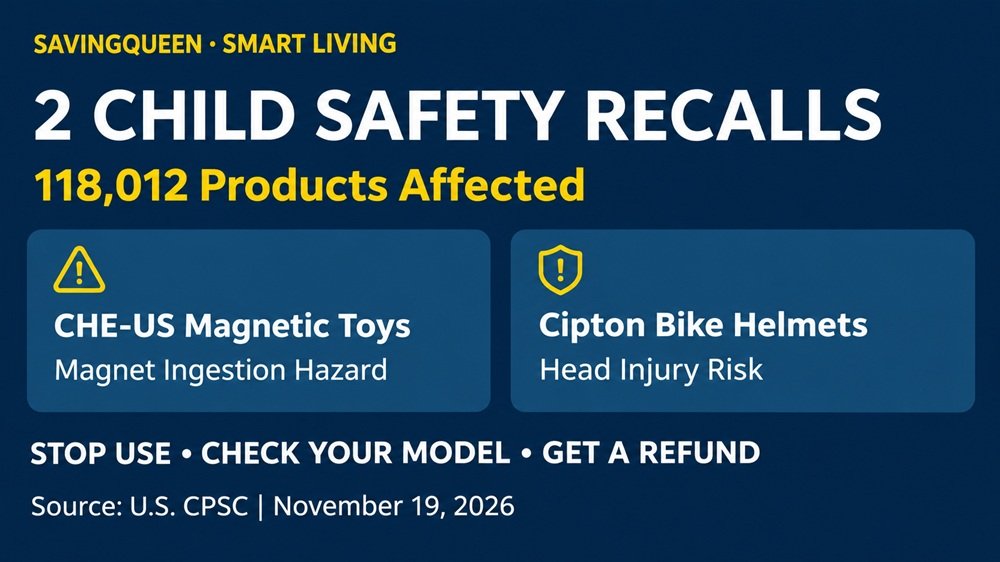
On November 19, 2026, the U.S. Consumer Product Safety Commission (CPSC) announced two major recalls involving 118,012 magnetic toys and bicycle helmets sold in the United States.
One involves small, powerful magnets that can cause life-threatening internal injuries if swallowed. The other involves bicycle helmets that may not adequately protect a child’s head during a crash.
Both recalls offer full refunds.
Before the holiday shopping season gets underway, parents should check whether these products are already in their homes.
1. Two Child Safety Recalls at a Glance
| Recall details | CHE-US Magnetic Robot Toys | Cipton Bicycle Helmets |
|---|---|---|
| Recall date | November 19, 2026 | November 19, 2026 |
| Units recalled | About 101,282 | 16,730 |
| Main hazard | Magnet ingestion | Head injury |
| Sold at | Amazon | Dick’s Sporting Goods, JCPenney |
| Original price | $9–$18 | About $35 |
| Remedy | Full refund | Full refund |
| CPSC recall number | 27-096 | 27-098 |
No incidents or injuries had been reported for either recall when CPSC published the announcements.
However, the absence of reported injuries does not mean an affected product is safe to use.
Both recalls require immediate action.
2. CHE-US Magnetic Robot Toys: The Hidden Danger Inside Colorful Figures
Magnetic toys can be entertaining because children can connect, separate, and rearrange pieces to create different shapes.
The CHE-US Magnetic Robot Toys were designed around that idea.
Unfortunately, these toys contain a potentially dangerous defect.
Why were the toys recalled?
According to CPSC, the arms and legs of the magnetic figures can release small, high-powered magnets when pulled apart.
If a child swallows multiple magnets, the magnets can attract one another through the walls of the digestive tract.
This can cause serious internal injuries, including intestinal blockage, perforation, twisting, infection, and even death.
Unlike swallowing some ordinary small objects, swallowing strong magnets creates an additional danger because separate magnets can pull together inside the body.
And a child may not immediately show obvious symptoms.
If you suspect a child has swallowed a magnet, seek emergency medical evaluation immediately. Do not wait for symptoms to develop.
Which magnetic toys are affected?
The recall covers CHE-US magnetic robot-shaped stick figures sold in sets of five or 10.
The figures come in five colors:
- Purple
- Blue
- Yellow
- Red
- Green
Each figure has four small magnets, with one located in each hand and foot.
The packaging includes the identifying code:
X004N3MGCB
The toys were sold through Amazon from April 2025 through August 2026 for approximately $9–$18.
The seller is Guangzhou Shian Trading Co., Ltd., operating as CHE-US/CHESLICR.
How to get your refund
CPSC instructs consumers to stop using the toys immediately and remove them from children’s reach.
To request a full refund:
- Find the recalled toys and check the product or packaging information.
- Contact CHE-US using the official recall email.
- Follow the recall instructions to photograph the toys in the trash.
- Send the required photograph to the company.
- Complete disposal in accordance with the recall instructions.
Recall email: CHE-USMagneticRobotToysRecall@outlook.com
Keep the toys and all loose magnets inaccessible to children throughout the process. If you discover separated magnets, secure them so children or pets cannot reach them.
Don’t donate, resell, or give away the recalled toys.
View the official CHE-US recall and product photographs on CPSC.gov.
An important update: The warning became a recall
This case has an unusual history.
On October 29, 2026, CPSC issued a safety warning telling consumers to stop using CHE-US magnetic figures because the seller had not agreed to an acceptable recall.
On November 19, CPSC announced a formal recall that includes a refund remedy.
That distinction matters.
If you previously saw a warning advising you to discard the product, the November recall provides a specific opportunity to request compensation.
The safety recommendation remains unchanged: stop using the affected toys immediately.
3. Cipton Bicycle Helmets: When Protective Equipment Fails Safety Standards
When parents purchase a bicycle helmet, they expect it to help protect their child’s head in a fall or crash.
A helmet may look sturdy, fit comfortably, and include attractive safety-related features.
But appearance alone cannot establish whether it meets mandatory impact-protection standards.
That’s the concern behind the Cipton bicycle helmet recall.
Why were the helmets recalled?
CPSC found that the affected helmets do not meet federal requirements for:
- Impact attenuation
- Positional stability
- Certification
Impact attenuation refers to a helmet’s ability to reduce the forces transmitted to the head during an impact.
Positional stability concerns whether the helmet remains properly positioned when protection is needed.
If these requirements aren’t met, a helmet may fail to adequately protect the wearer during a crash.
The recall involves a serious risk of head injury or death.
Which Cipton helmets are affected?
The recalled helmets have several identifying features.
| Feature | Recalled helmet |
|---|---|
| Brand | Cipton |
| Model | CPSK300CC |
| Color | White |
| Size | Youth Small (S) |
| Head circumference | About 19.7–21.3 inches |
| Padding and straps | Black |
| Special feature | Built-in multicolored LED light strip |
The model number is printed on a label inside the helmet.
Approximately 16,730 helmets were sold through Dick’s Sporting Goods and JCPenney, as well as online through Dick’s Sporting Goods, between April 2024 and May 2026.
The retail price was approximately $35.
How to request a full refund
Cipton is providing full refunds for recalled helmets.
The official procedure requires consumers to:
- Stop using the affected helmet immediately.
- Contact Cipton or visit the recall website.
- Cut the helmet straps to prevent further use.
- Write “Recalled” on the helmet using a permanent marker.
- Photograph the destroyed helmet.
- Email the required photograph to the recall administrator.
Recall phone: 888-588-1629
Hours: Monday–Friday, 9 a.m.–5 p.m. Eastern Time
Recall email: Reply@customersupport123.com
Official recall website: Southern Telecom — Cipton Recall
View the official Cipton recall and product photographs on CPSC.gov.
Important: Don’t throw the helmet into ordinary trash
The CPSC notice also includes a lithium-ion battery disposal warning.
Because the helmet contains an electronic lighting feature, owners should follow the published disposal precautions.
Do not put the recalled device into household trash, curbside recycling, or a standard retail battery recycling box.
Contact your municipal household hazardous waste facility to ask whether it accepts defective lithium-ion battery devices.
If it does not, request further instructions from your municipality or the recall administrator.
4. Why These Recalls Matter Even If Your Child Has Never Been Injured
Parents sometimes hesitate to stop using a product that has worked without problems.
Perhaps the magnetic figures have been used for months without breaking.
Perhaps a child has worn the helmet for hundreds of bicycle rides.
But product safety isn’t established simply by a history of uneventful use.
The magnetic toy hazard may not become apparent until a component separates.
The helmet problem may only become apparent during the crash when protection matters most.
That is what makes these two recalls particularly important.
Both involve hazards that can be difficult for ordinary consumers to detect through visual inspection.
A parent cannot reliably determine the strength and safety of an embedded magnet just by looking at it.
Similarly, a helmet’s impact performance cannot be established by squeezing its shell or checking whether its straps feel secure.
Official safety testing and mandatory product standards exist for precisely these reasons.
5. How to Check Your Amazon and Retail Purchase History
Many affected products were sold months or even years before the recall announcements.
You may no longer remember exactly when you purchased them.
Fortunately, online purchase records can help.
For CHE-US magnetic toys
Open your Amazon order history and search for CHE-US, CHESLICR, magnetic robot, or magnetic stick figures.
Look for purchases between April 2025 and August 2026.
Compare the order photograph with the official CPSC product images and check for packaging code X004N3MGCB.
For Cipton bicycle helmets
Review any purchases made at Dick’s Sporting Goods or JCPenney between April 2024 and May 2026.
Inspect the helmet’s interior label for model CPSK300CC.
Don’t rely on color or appearance alone. Compare all identifying information with the official recall notice.
Keep purchase confirmations and identification photographs until the refund process is complete.
If the item was received as a gift, ask the recall administrator whether additional documentation is needed.
6. How Much Money Could You Recover?
Both companies are offering full refunds.
Consider a hypothetical household that purchased a CHE-US toy set for $15 and a Cipton helmet for $35.
| Recalled item | Illustrative original price |
|---|---|
| CHE-US Magnetic Robot Set | $15 |
| Cipton Bicycle Helmet | $35 |
| Total purchase value | $50 |
The original combined purchase value would be $50.
The actual amount refunded depends on the affected purchases and the applicable recall procedures.
The important financial lesson isn’t simply that a household could recover $50.
It’s that consumers should not feel obligated to keep dangerous products just because they’ve already paid for them.
The purchase price is a sunk cost. Continuing to use a recalled item does not recover that expense.
Claiming the available remedy and replacing necessary protective equipment is the safer approach.
7. Save or Skip: What Should Parents Do?
SAVE — Purchase records and recall documentation
Keep receipts, online order records, identifying labels, and copies of communication with the recall administrator.
SKIP — Continued use of recalled products
Don’t let children keep playing with the magnetic figures.
Don’t allow a child to ride with the recalled helmet, even for a short distance.
CLAIM — Official refunds
Use the contact information provided by CPSC rather than unfamiliar links in unsolicited emails or advertisements.
REPLACE — Necessary safety equipment
If your child regularly rides a bicycle, obtain a properly fitting replacement helmet that meets applicable safety standards before allowing riding to resume.
8. What Should You Look for When Buying a Replacement Bicycle Helmet?
A replacement helmet should do more than look attractive.
Check for a label indicating that the helmet complies with the U.S. CPSC bicycle helmet safety standard.
Choose the correct size for your child’s head circumference.
Make sure the helmet sits level, fits securely, and does not shift excessively when the child moves their head.
Adjust the straps according to the manufacturer’s instructions.
A built-in light can improve visibility, but it does not replace the helmet’s primary job: reducing head-injury risk during a crash.
Also remember that bicycle helmets are designed for particular activities. A helmet advertised for another sport may not necessarily meet the requirements for bicycle riding.
Before purchasing, search the brand and model in the CPSC recall database.
9. Five-Minute Family Product Safety Check
With holiday shopping underway, it’s an especially useful time to inspect children’s toys and protective equipment.
Start with the products your family already owns.
Check magnetic building sets, magnetic figures, and toys with small removable components.
Look inside bicycle helmets for model information and safety labels.
Review older toys that may have been stored for younger siblings or visiting relatives.
Search online purchase histories for recalled brands.
Finally, check CPSC.gov/Recalls before donating or reselling used children’s products.
A few minutes of checking could prevent a much more serious problem.
The Bottom Line
The CHE-US magnetic robot toy recall and Cipton bicycle helmet recall concern two very different types of products.
One is designed for play. The other is intended to protect children from injury.
But both cases demonstrate why product safety cannot be judged by appearance, price, or past experience alone.
If you own either recalled item, stop using it, verify the product information, and follow the official refund instructions.
For parents, the most valuable saving isn’t the money recovered from a recall.
It’s protecting children from injuries that may be preventable.
Frequently Asked Questions
Are all magnetic robot toys being recalled?
No. This recall specifically covers CHE-US magnetic robot stick figures identified in CPSC Recall 27-096. Other magnetic toys may have separate recalls or safety warnings.
How can I identify the CHE-US toys?
Look for sets of five or 10 colorful magnetic stick figures. Packaging code X004N3MGCB is an important identifier.
Is every Cipton bicycle helmet recalled?
No. This announcement concerns the white youth-size-small helmet with model number CPSK300CC.
Does the Cipton helmet recall apply if the LED lights still work?
Yes. The recall concerns impact protection, positional stability, and certification requirements—not simply whether the electronic lighting functions.
Were injuries reported?
Neither November 19 recall notice listed reported incidents or injuries as of its publication.
Can I donate recalled toys or helmets?
No. Follow the official recall process. Do not pass affected products to another family.
What should I do if my child may have swallowed a magnet?
Seek emergency medical evaluation immediately, even if the child appears well.
Official Sources
- CPSC Recall 27-096 — CHE-US Magnetic Robot Toys
- CPSC Warning 27-053 — Earlier CHE-US Magnetic Toy Safety Warning, October 29, 2026
- CPSC Recall 27-098 — Cipton Bicycle Helmets
- CPSC — Search Product Recalls
- CPSC — Report Unsafe Products
Last reviewed: November 23, 2026. Recall details and remedies may change. Always consult the official CPSC notices for current instructions. This article provides general consumer safety information.