
You are shopping for a product and notice two similar options.
One costs $100. The other costs $120, but its packaging proudly says “Made in USA.”
You choose the more expensive product because you believe it was manufactured in America. Maybe you want to support American workers. Maybe you associate domestic manufacturing with better oversight or simply prefer to know where your products come from.
But what if the product was assembled in the United States using major components imported from other countries?
Would the “Made in USA” label still be accurate?
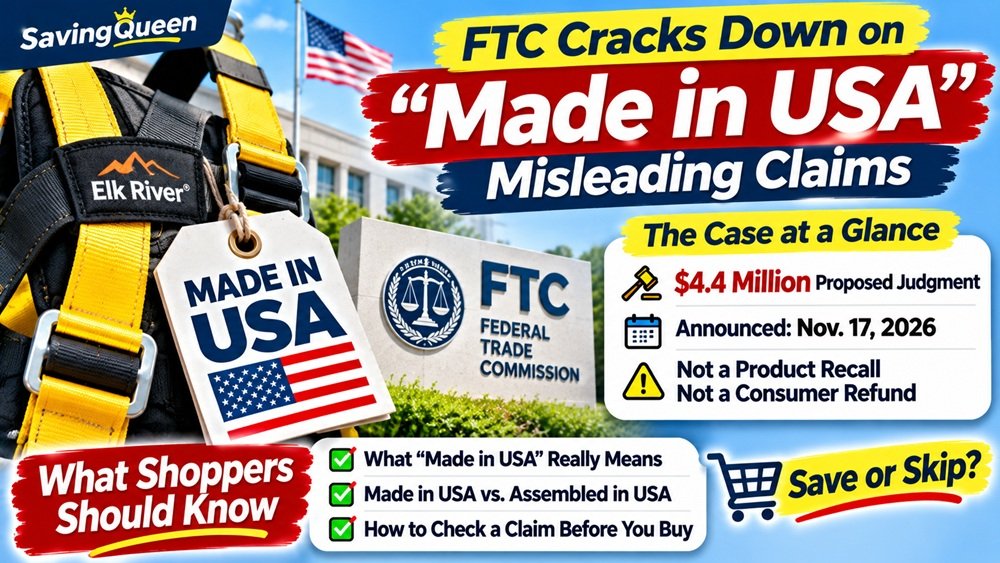
That question is at the center of a new Federal Trade Commission (FTC) enforcement action announced on November 17, 2026.
The case involves Elk River Inc., an Alabama-based company that manufactures safety harnesses and other fall-protection equipment.
But the lesson goes far beyond industrial safety equipment. It applies to anyone who shops for appliances, furniture, clothing, tools, electronics, or other products advertised as American-made.
1. Why the FTC Took Action Against Elk River
According to the FTC’s complaint, Elk River advertised certain safety harnesses using statements such as “Made in USA,” “American-made,” and “#madeinalabama.”
These claims appeared in marketing materials, on the company’s website, on social media, and on product labels.
There was one important problem, according to the FTC.
Although the harnesses underwent final assembly at a facility in Alabama, most of their components and materials came from outside the United States.
The FTC alleged that this included components important to the equipment’s function and safe operation.
The agency argues that the company made broad claims of U.S. origin without meeting the legal standard for those claims.
Under the proposed settlement, Elk River faces a $4.4 million monetary judgment.
However, the judgment would be suspended after the company pays $72,527 because of its reported inability to pay the full amount. The full judgment could become payable if the company misrepresented its financial condition.
The proposed order would also restrict misleading country-of-origin claims and require consumer notification.
As of November 18, 2026, the case remains pending. The stipulated order requires court approval to become enforceable.
Important: This is an advertising and product-origin case. The FTC announcement does not establish that Elk River’s harnesses are defective, announce a safety recall, or create a public refund program.
2. What Does “Made in USA” Legally Mean?
Many shoppers assume a product can be called American-made as long as it is assembled in an American factory.
That isn’t necessarily true.
Under the FTC’s Made in USA standard, an unqualified claim—one that simply says “Made in USA” without any explanation—generally requires the product to be:
- Finally assembled or processed in the United States.
- Subject to all significant processing in the United States.
- Made from all or virtually all U.S.-sourced ingredients and components.
The FTC calls this the “all or virtually all” standard.
That phrase matters because it means a manufacturer cannot automatically claim a product is American-made simply because workers in an American factory put the final pieces together.
The origin and importance of the materials must also be considered.
For example, imagine a company assembles a power tool in Ohio, but the motor, electronic controls, and other critical components are imported.
The company may be able to describe certain manufacturing steps accurately.
However, a broad “Made in USA” claim could be misleading if the product does not meet the FTC’s domestic-content standard.
The agency also evaluates the significance of foreign parts, not merely their cost.
There is no universal rule that a product becomes FTC-compliant just because a particular percentage of its retail price or manufacturing cost is domestic.
3. “Made in USA” vs. “Assembled in USA”: What’s the Difference?
These phrases may look similar on a package, but they communicate different information.
| Label | What it generally tells you |
|---|---|
| Made in USA | The product meets the FTC’s all-or-virtually-all domestic manufacturing standard |
| Assembled in USA | Principal, substantial assembly took place in the U.S., potentially using imported components |
| Made in USA with Imported Parts | The manufacturer acknowledges imported parts; the claim must still be truthful and adequately supported |
| Designed in USA | The design work occurred in the U.S.; it does not establish where the product was manufactured |
| American-Owned Company | Describes ownership, not necessarily the product’s manufacturing origin |
Consider a kitchen appliance.
The packaging says “Designed in California,” and the company maintains an office in San Francisco.
Neither detail proves the appliance was manufactured in the United States.
Likewise, an American flag on a package doesn’t automatically mean the product meets the FTC standard. Depending on the overall presentation, patriotic imagery can contribute to an implied origin claim.
There is another detail worth knowing: the FTC does not routinely preapprove Made in USA claims before companies use them.
Businesses are responsible for supporting their own claims, and regulators can challenge them when the evidence does not meet the applicable standards.
4. Why an Incorrect Label Can Cost Shoppers Money
Think about the $100 and $120 products from our opening example.
You pay $20 extra because you believe the second product was made in America.
<text></text>
Illustrative shopping comparison
| Product A | Product B | |
|---|---|---|
| Price | $100 | $120 |
| Additional cost | — | $20 |
| Price premium | — | 20% |
If the only reason you selected Product B was its American-made claim, a misleading label could affect your purchasing decision.
That $20 difference is real money.
But there is an important distinction.
The FTC does not say that every American-made product costs 20% more. This is a hypothetical example showing how an origin claim can affect what a shopper is willing to pay.
The same issue can arise with products marketed as organic, environmentally friendly, locally produced, or manufactured under particular standards.
A marketing claim has value because consumers may make buying decisions based on it.
When the claim is inaccurate, shoppers may not receive the attribute they believed they purchased.
5. Does “Made in USA” Mean Better Quality or Greater Safety?
Not automatically.
A product’s country of origin tells you something about where manufacturing occurred.
It does not, by itself, guarantee:
- Better materials.
- Longer product life.
- Greater durability.
- Superior safety performance.
- Fewer defects.
- Better customer support.
A well-made imported product can outperform a poorly made domestic product, and the reverse can also be true.
In the Elk River case, the FTC’s concern is whether the company’s origin claims were accurate.
The announcement should not be interpreted as a finding that its products failed safety tests.
For safety-critical equipment, shoppers should examine applicable safety standards, certifications, product instructions, independent testing information, and recall notices rather than relying on country of origin alone.
Country of origin and product quality are different questions.
6. Five Ways to Check an American-Made Claim Before Buying
You don’t have to investigate every component in every product you purchase.
But when an American-made claim is one of the reasons you’re paying more, a few simple steps can help.
Step 1: Read the exact wording
Don’t treat “American company,” “designed in America,” and “Made in USA” as interchangeable.
Look for qualifications such as “with imported components.”
Step 2: Check the manufacturer’s product page
See whether the company explains where the product is assembled and where important materials are sourced.
Be cautious when a brand makes a company-wide claim without identifying which specific products qualify.
Step 3: Look for consistency
Compare the packaging, online listing, technical specifications, and manufacturer’s description.
If one says “Made in USA” and another identifies substantial foreign manufacturing, ask the seller to clarify.
Step 4: Ask about the specific product
Some companies make products in multiple countries.
The relevant question is not simply where the business is headquartered.
Ask: “Where is this particular model manufactured, and are its main components domestic or imported?”
Step 5: Save the information that influenced your purchase
If origin matters to your decision, retain a screenshot of the product listing, the receipt, and any written representation.
That documentation may help if you later discover the claim was misleading.
7. What Should You Do If You Discover a Misleading Label?
Suppose you purchased an item specifically because it was advertised as American-made.
Later, you find credible information suggesting the claim was inaccurate.
Start with the retailer.
Explain what the product listing said, provide your receipt, and ask whether a return, refund, or other adjustment is available.
The outcome may depend on store policy, applicable law, the purchase date, and the facts of the transaction.
If you suspect a violation of the FTC’s Made in USA standard, you can report it.
Official reporting options:
- ReportFraud.ftc.gov — Report potentially deceptive business practices.
- MUSA@ftc.gov — The FTC identifies this address for reports about potential Made in USA noncompliance.
You can also review the FTC’s Made in USA compliance guidance.
Filing a complaint does not guarantee an individual refund. The FTC uses consumer reports to help identify potentially unlawful practices.
8. Save or Skip: Is Paying More for “Made in USA” Worth It?
The best answer depends on what you’re trying to achieve.
If supporting domestic manufacturing is a priority, a properly supported Made in USA claim can be meaningful information.
But if you’re paying a significant premium primarily for quality or durability, compare measurable product features as well.
<text></text>
SAVE: Paying attention to precise country-of-origin language, checking the manufacturer’s evidence, and comparing warranties and specifications.
SKIP: Assuming that an American flag, a U.S. business address, or an American-sounding brand name proves domestic manufacturing.
COMPARE: The extra cost against your reason for choosing the product.
Here’s a useful shopping exercise.
If a domestically marketed item costs $150 while a comparable alternative costs $125, the additional cost is $25—or 20% of the lower-priced option.
Ask yourself whether the product’s documented origin, performance, warranty, and other benefits justify that amount.
You may decide they do.
Or you may decide that a less expensive product meets your needs just as well.
The goal isn’t to tell you which country to buy from.
It’s to help you make that decision using accurate information.
9. What the Elk River Case Really Teaches Consumers
The FTC’s action against Elk River highlights a problem that is easy to overlook during everyday shopping.
A product can have an American brand, an American factory, and American workers involved in its production while still containing substantial imported components.
None of those facts is inherently wrong.
Modern manufacturing often involves international supply chains.
The issue arises when a company makes a broader country-of-origin claim than the facts support.
The FTC’s Made in USA rules are intended to make those distinctions meaningful.
For shoppers, the lesson is simple:
Don’t pay extra for a label until you understand what the label actually promises.
A little research before checkout can help protect both your money and your ability to make informed choices.
Frequently Asked Questions
Can a product use imported parts and still say “Made in USA”?
Potentially, if the foreign content is negligible and the product otherwise meets the FTC’s all-or-virtually-all standard. Significant imported components generally make an unqualified claim inappropriate.
Does “Assembled in USA” mean the parts are American-made?
No. The claim can be appropriate for products containing imported parts when substantial assembly and other applicable conditions are met.
Does the FTC certify every product labeled “Made in USA”?
No. The FTC does not generally preapprove individual manufacturers’ Made in USA advertising claims.
Is the $4.4 million Elk River judgment going to customers?
The FTC’s November 17 announcement does not establish a consumer refund program. The $4.4 million figure is a proposed monetary judgment, largely suspended under specified conditions.
Does the Elk River enforcement action mean its harnesses are unsafe?
No such conclusion follows from the FTC’s announcement. The case addresses allegedly misleading origin claims, not an announced product defect or safety recall.
How can I report a potentially false Made in USA claim?
You can submit information through ReportFraud.ftc.gov or contact the FTC at MUSA@ftc.gov.
Official Sources
- FTC — Enforcement Action Against Elk River, November 17, 2026
- FTC — Elk River Case and Court Documents
- FTC — Complying with the Made in USA Standard
- FTC — Made in USA Labeling Rule
- FTC — Report Fraud
Last reviewed: November 18, 2026. This article provides general consumer education, not legal advice. Enforcement proceedings and proposed settlements may change after publication.