
November 17, 2026 | SavingQueen
Imagine opening your mail and discovering that your health insurance plan has changed—even though you never requested a change.
Or receiving a call from someone who claims to represent Medicare and offers you a free medical device. All they need, the caller says, is your Medicare number.
These situations may sound unrelated, but they point to a larger problem in America’s healthcare system: fraud can affect not only government spending but also the people who depend on their insurance coverage.
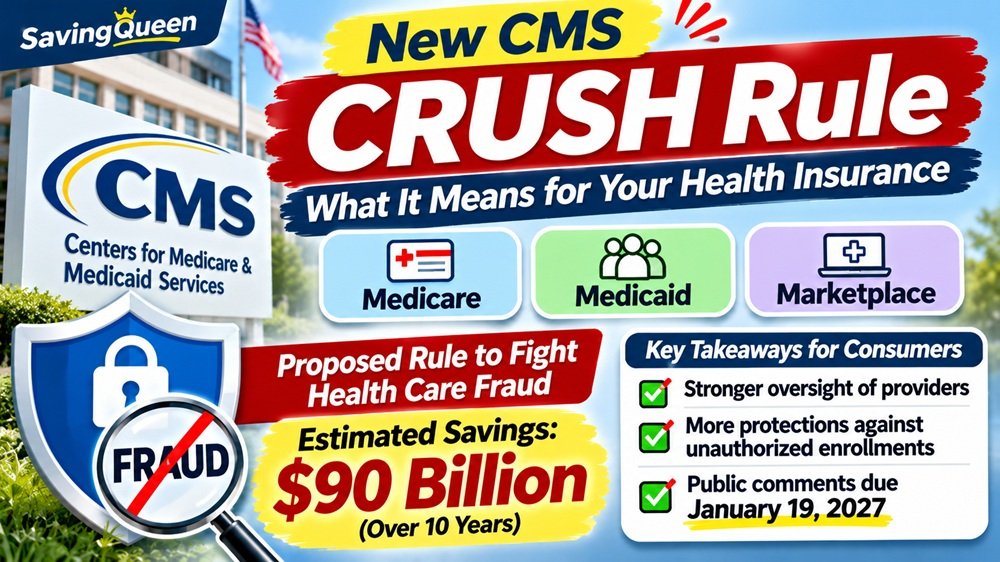
On November 16, 2026, the Centers for Medicare & Medicaid Services (CMS) announced a proposed regulation called CRUSH, short for Comprehensive Regulations to Uncover Suspicious Healthcare.
The proposal, officially designated CMS-6098-P, aims to strengthen fraud prevention across Medicare, Medicaid, the Children’s Health Insurance Program (CHIP), and the Health Insurance Marketplace.
CMS estimates that the proposed changes could generate nearly $90 billion in federal budget savings over 10 years.
But what does that mean for people who actually use these programs?
Will your coverage change? Will you need to complete additional paperwork? Could your doctor be affected?
Here’s what consumers should know.
1. What Is the CMS CRUSH Proposed Rule?
CRUSH is a federal regulatory proposal designed to help CMS identify and prevent healthcare fraud, improper payments, and abuse before they become larger problems.
Instead of relying primarily on investigations after questionable payments occur, the proposal would strengthen several safeguards.
These include:
- More extensive screening of healthcare providers and suppliers.
- Stronger reporting requirements for Medicare Advantage and Part D plans.
- Greater oversight of Medicaid and CHIP providers.
- Additional safeguards against unauthorized Marketplace enrollments.
- Expanded restrictions on unsolicited marketing by certain medical equipment suppliers.
The central idea is straightforward: make it harder for dishonest individuals or businesses to obtain healthcare payments or manipulate consumers’ insurance coverage.
However, CRUSH is a proposed rule, not a final regulation.
The announcement does not mean every proposed requirement is already in effect.
2. Medicare Members: Watch for Unwanted Medical Equipment Offers
One area of the proposal focuses on companies supplying durable medical equipment, prosthetics, orthotics, and related supplies.
These businesses may provide medically necessary products such as wheelchairs, braces, and certain medical devices.
But medical equipment can also be used in fraudulent billing schemes.
For example, someone might contact a Medicare beneficiary offering a free back brace.
The person may request the beneficiary’s Medicare number and then submit a claim for equipment that was never medically necessary or properly authorized.
CMS is proposing stronger restrictions on unsolicited contact by certain medical equipment suppliers.
Existing rules already restrict unsolicited telephone contact, subject to exceptions. CRUSH would expand protections involving text messages, certain emails, social media direct messages, and door-to-door solicitation.
What Medicare members should do
If someone contacts you unexpectedly about free medical equipment:
- Don’t provide your Medicare number immediately.
- Ask for the company’s name and contact information.
- Verify any medical need with your healthcare provider.
- Review your Medicare Summary Notice or Explanation of Benefits for unfamiliar claims.
- Report suspicious Medicare activity to 1-800-MEDICARE (1-800-633-4227).
A legitimate Medicare card is not something you should share simply because a caller promises a free product.
3. Medicare Advantage: Could Your Doctor Be Affected?
CRUSH also proposes stronger oversight of healthcare providers participating in Medicare Advantage plans.
Under the proposal, eligible providers and suppliers billing Medicare Advantage would generally need approved enrollment in Original Medicare, with a specified exception for PACE plans.
This would allow CMS to apply additional screening procedures before those providers participate in Medicare Advantage billing.
If finalized, the requirement would take effect on the first day of the plan year beginning two years after publication of the final rule.
That means it is not an immediate requirement for every provider today.
Could this affect patients?
Potentially, but the effect will depend on the final rule and how insurers and providers implement it.
Stronger provider screening could help prevent fraudulent billing.
At the same time, new administrative requirements may create additional work for legitimate providers.
For consumers, the practical lesson is to verify that preferred doctors, hospitals, and specialists participate in a plan before enrolling or changing coverage.
If you receive a notice that a provider is leaving your network, contact the insurer directly rather than assuming the CRUSH proposal caused the change.
4. Marketplace Insurance: Protection Against Unauthorized Enrollment
This may be one of the most directly relevant parts of the proposal for working families and people purchasing their own health insurance.
Marketplace agents and brokers help consumers compare plans and enroll in coverage.
Most perform legitimate services.
However, unauthorized enrollment or plan switching can create serious problems.
Imagine that you selected a Marketplace health plan because your doctor accepts it and the monthly premium fits your budget.
Later, you discover that your coverage was changed without your permission.
You may face unexpected bills, different deductibles, or problems accessing your preferred providers.
The CRUSH proposal would strengthen CMS authority to suspend or terminate Marketplace agreements with agents, brokers, and web-brokers involved in certain abusive practices.
It would also impose additional participation restrictions related to specified criminal convictions and prior misconduct.
How to protect your Marketplace coverage
- Review your current plan name, premium, deductible, and coverage dates.
- Check enrollment notices for changes you did not request.
- Never share your Marketplace account password with an unknown caller.
- Be cautious of agents promising unusually large benefits without explaining eligibility.
- Contact the Marketplace directly if your coverage changes unexpectedly.
For federally facilitated Marketplace coverage, visit HealthCare.gov or call 1-800-318-2596.
Residents of states operating their own Marketplaces should use their state’s official enrollment website.
5. Medicaid and CHIP: Stronger Oversight Doesn’t Mean Automatic Loss of Coverage
CRUSH proposes several changes to Medicaid and CHIP program integrity.
These include additional provider identification requirements, more detailed fraud reporting, stronger oversight of provider enrollment, and changes to how states review eligibility-related errors.
CMS also proposes improvements to electronic visit verification and reporting of certain overpayments.
These provisions primarily concern government agencies, healthcare providers, and organizations administering Medicaid programs.
They should not be confused with a blanket announcement that Medicaid beneficiaries must immediately reapply for coverage.
The CRUSH proposal does not, by itself, cancel anyone’s Medicaid or CHIP coverage.
However, eligibility rules and renewal requirements remain important.
Consumers should continue responding to legitimate renewal notices and keeping contact information current with their state Medicaid agency.
If you receive an unexpected termination notice, verify it directly with the agency and review the appeal instructions and deadlines.
6. What Does the Nearly $90 Billion Savings Estimate Actually Mean?
The headline number is substantial.
CMS estimates that the quantified provisions of CRUSH would produce nearly $90 billion in federal budget savings between 2027 and 2036.
The agency also estimates approximately $378.51 million in associated costs over that period.
But these figures require context.
The savings are projections based on the agency’s analysis—not money already recovered.
They also do not represent a consumer refund program or a promised reduction in individual health insurance premiums.
Some projected savings depend on recovering improper Medicare Advantage payments or preventing other inappropriate expenditures.
Whether the estimates are realized will depend on the final regulation, implementation, compliance, and actual enforcement outcomes.
For consumers, the distinction matters:
Government savings do not automatically translate into lower monthly premiums or personal refund checks.
7. Does the CRUSH Rule Change Your Health Insurance Today?
As of November 17, 2026, the CRUSH regulation remains a proposal.
Here’s what that means for consumers.
| Question | Current answer |
|---|---|
| Is CRUSH a final rule? | No |
| Does it automatically cancel Medicare or Medicaid coverage? | No |
| Must every beneficiary submit new paperwork because of CRUSH? | No |
| Are new consumer refunds being offered? | No |
| Could future provider or broker requirements change? | Yes, if provisions are finalized |
| Can the public comment? | Yes, through January 19, 2027 |
Consumers should distinguish between the proposed CRUSH changes and existing insurance obligations.
For example, regular Medicaid renewals and Medicare or Marketplace enrollment deadlines may still apply independently of this proposal.
8. Five Things You Can Do Right Now
You don’t need to wait for a new federal regulation to protect your health insurance information.
First, verify unexpected calls. If someone claims to represent Medicare, Medicaid, or the Marketplace, contact the relevant agency using an official number rather than the number provided by the caller.
Second, review insurance statements. Look for medical equipment, appointments, prescriptions, or services you don’t recognize.
Third, monitor plan changes. Compare your insurance identification card and enrollment records with the plan you actually selected.
Fourth, protect personal information. Don’t provide your Social Security number, Medicare number, or Marketplace login credentials to unsolicited callers.
Fifth, keep documentation. Save suspicious messages, enrollment notices, and communications with insurers or agencies.
These habits are useful regardless of whether CRUSH becomes final.
9. How to Comment on the Proposed Rule
CMS is accepting public comments on the CRUSH proposal.
The announced deadline is January 19, 2027.
Consumers, healthcare providers, insurers, and other interested parties may submit feedback.
For example, a consumer might support stronger protections against unauthorized Marketplace enrollment while asking CMS to ensure legitimate agents can continue helping people who have difficulty navigating insurance websites.
A healthcare provider might raise questions about the administrative burden of new enrollment requirements.
Public comments can help federal agencies evaluate potential consequences before issuing a final rule.
To find the proposal, search for CMS-6098-P or Comprehensive Regulations to Uncover Suspicious Healthcare through Regulations.gov.
Check the official docket instructions before submitting a comment, and avoid including sensitive personal information in a public submission.
10. SavingQueen’s Takeaway: Protect Your Coverage Before Problems Happen
Healthcare fraud is often discussed in terms of billions of dollars in government spending.
But behind those numbers are people who depend on their insurance to receive medical care.
A fraudulent medical equipment claim can misuse a beneficiary’s information.
An unauthorized Marketplace enrollment can disrupt access to doctors.
And weak oversight of healthcare providers can create risks that extend beyond financial losses.
CRUSH is an attempt to strengthen the systems intended to prevent these problems.
Whether it succeeds will depend on the final requirements and how they are enforced.
For now, consumers don’t need to panic or make insurance changes simply because this proposal was announced.
Instead, focus on what you can control: verify communications, review your coverage, monitor claims, and report suspicious activity.
The best insurance protection starts with knowing what coverage you have—and recognizing when something doesn’t look right.
Frequently Asked Questions
Is the CMS CRUSH rule already in effect?
No. CMS announced CRUSH as a proposed rule on November 16, 2026. Its proposed requirements are not automatically effective.
Will CRUSH reduce my Medicare premium?
There is no announced individual premium reduction resulting from CRUSH. The nearly $90 billion figure refers to projected federal budget savings, not guaranteed consumer savings.
Could CRUSH affect my Medicare Advantage doctor?
Potentially, if the provider enrollment requirements are finalized. However, the proposal does not mean that your current doctor is automatically removed from your plan.
Does CRUSH change Medicaid eligibility requirements?
The proposal includes Medicaid eligibility oversight provisions, but it does not automatically terminate an individual’s coverage or replace existing renewal requirements.
What should I do if someone changed my Marketplace plan without permission?
Contact your official Marketplace promptly, report the unauthorized change, and request assistance correcting your enrollment. Keep records of notices and conversations.
When is the deadline to comment?
CMS announced January 19, 2027, as the public comment deadline.
Official Sources
- CMS — CRUSH Proposed Rule Fact Sheet, November 16, 2026
- CMS — CRUSH Proposed Rule Press Release
- Federal Register — CRUSH Proposed Rule, CMS-6098-P (PDF)
- Medicare.gov — Protect Yourself from Medicare Fraud
- HealthCare.gov — Official Health Insurance Marketplace
Last reviewed: November 17, 2026. This article provides general consumer education and does not constitute legal, medical, or insurance advice. The proposed rule may change before finalization.