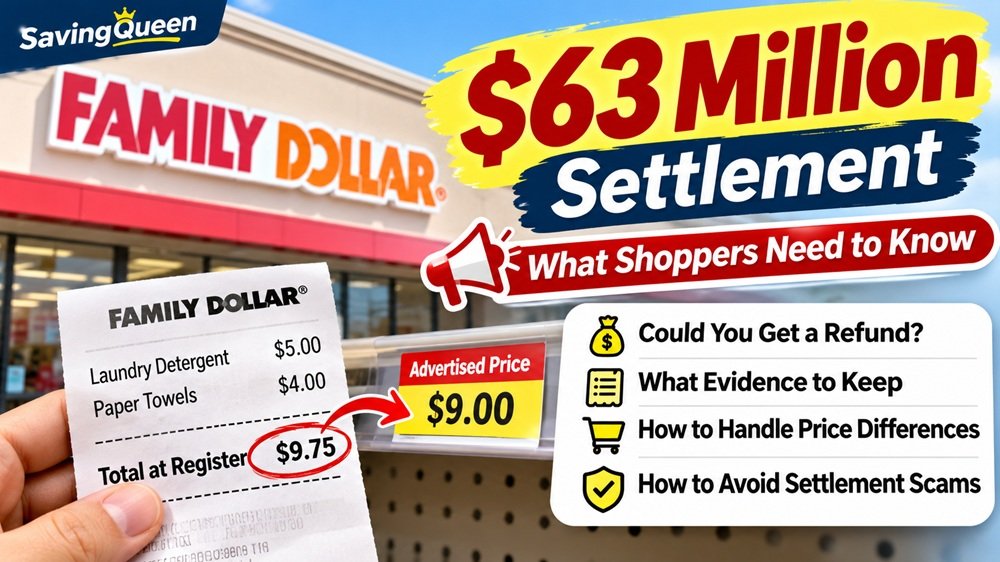
You walk into Family Dollar to buy a few household essentials. A bottle of detergent is marked $5. A package of paper towels is advertised for $4. You pick up a few more items, pay at the register, and head home.
But what if the prices on your receipt are higher than the prices you saw on the shelves?
You might never notice a difference of 50 cents or a dollar. And even if you do, you may decide it isn’t worth returning to the store.
Now imagine that happening to thousands of shoppers, week after week.
That’s the problem at the center of a major new settlement involving Family Dollar.
On November 12, 2026, the Federal Trade Commission (FTC) and 17 states announced a proposed $63 million settlement with Family Dollar over allegations that customers were repeatedly charged more at checkout than the prices advertised in stores and online.
The proposed settlement includes $40 million for consumer compensation and $20 million in customer discounts.
But here’s the question shoppers really want answered:
If you’ve shopped at Family Dollar, could you receive money back?
The answer is potentially yes—but there are important details you should understand before expecting a payment.
What Happened at Family Dollar?
According to the FTC’s complaint, Family Dollar allegedly charged customers higher prices at checkout than those displayed on store shelves, price tags, advertisements, and its website or mobile app.
The agency says the problems were not isolated mistakes.
Regulators alleged that thousands of stores experienced pricing discrepancies and that the company failed to adequately correct the problems despite repeated complaints, inspections, and enforcement actions.
The FTC also raised concerns about Family Dollar’s Smart Coupons.
Some customers allegedly could not redeem advertised discounts because the company’s mobile application failed to work properly at checkout.
This matters because customers make purchasing decisions based on the prices they see before paying.
A product advertised for $3.50 may seem like a good deal. If it rings up at $4.25, the customer is paying 75 cents more than expected.
One mistake may seem small. Repeated across many purchases, those differences can add up.
Family Dollar agreed to the proposed settlement without admitting or denying wrongdoing.
The case was filed in federal court in Virginia, and the settlement requires judicial approval before the stipulated order becomes enforceable.
Where Will the $63 Million Go?
The proposed settlement is divided into three major components.
| Settlement component | Amount |
|---|---|
| Consumer redress fund | $40 million |
| Customer discount program | $20 million |
| Payments to participating states | More than $3 million |
| Total announced settlement | Approximately $63 million |
The $40 million fund is intended to compensate eligible consumers harmed by the alleged pricing practices.
The separate $20 million program would provide discounts to Family Dollar customers.
The remaining payments would go to participating states.
However, this does not mean every shopper will receive a check or an equal share of the settlement.
The distribution process and individual eligibility requirements will determine who receives compensation and how much.
Who Is Eligible for a Family Dollar Refund?
This is the most important question—and the one that still requires patience.
As of November 13, 2026, the FTC has announced the proposed consumer redress fund, but a finalized public claims process and complete individual eligibility rules have not been established in the official announcement.
That means you should not assume that shopping at Family Dollar automatically qualifies you for a payment.
You also should not assume that you are excluded simply because you no longer have your receipts.
The settlement requires Family Dollar to notify eligible customers through notices in stores and on its digital platforms.
For now, the smartest approach is to preserve any evidence you already have and watch for official instructions.
What Should You Save?
If you believe you were charged more than an advertised price, consider keeping:
- Family Dollar receipts showing the amount paid.
- Screenshots of advertised prices or digital coupons.
- Photos of shelf tags showing a different price.
- Order confirmations or purchase records.
- Any written communication with Family Dollar customer service.
These records may help document a pricing discrepancy.
However, the FTC has not said that every consumer must provide these documents to qualify for the proposed fund.
How Much Could You Receive?
There is no confirmed individual payout amount.
The proposed $40 million consumer fund does not establish a fixed refund for every customer.
For example, dividing $40 million among one million eligible consumers would produce an average of $40 per person.
But that is only a mathematical illustration—not a prediction of actual payments.
Actual compensation could depend on the final eligibility rules, the number of qualifying consumers, and how the redress program is administered.
SavingQueen’s advice: Don’t count a potential settlement payment as money you’ve already saved.
Until the official process is announced, treat any estimated payout as uncertain.
What About the $20 Million Discount Program?
The discount program is separate from the consumer redress fund.
Under the proposed settlement, Family Dollar would provide $20 million in discounts to customers.
That sounds promising, but several practical questions remain.
Will discounts be distributed automatically? Will shoppers need a digital coupon? Will purchases have minimum spending requirements? How long will the program last?
The public announcement does not establish all of those consumer-facing details.
And there’s another important consideration.
A discount only saves you money if you actually need the product and the final price is competitive.
A $5 discount on a $30 purchase may sound attractive, but it isn’t a bargain if you buy unnecessary items just to qualify.
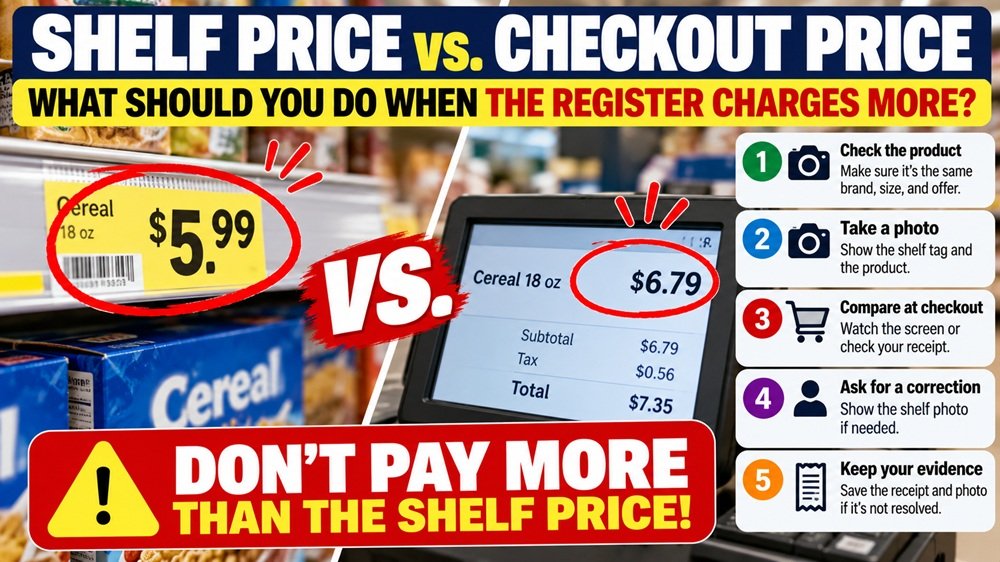
What Should You Do If the Register Price Is Higher Than the Shelf Price?
You don’t have to wait for a settlement to protect yourself.
Suppose you’re buying six items at Family Dollar. The advertised total is $21.50, but your receipt shows $24.00 before tax.
That’s a $2.50 difference.
Here’s a practical way to handle it.
Step 1: Review your receipt before leaving.
Compare the item prices with the shelf labels and advertised promotions.
Pay particular attention to sale items, multipack promotions, and digital coupons.
Step 2: Document the discrepancy.
If possible, take a photo of the shelf label showing the advertised price.
Keep the receipt showing the amount charged.
Step 3: Ask the store to correct the price.
Politely explain the difference and request a price adjustment or refund of the overcharge.
Step 4: Ask for a manager if necessary.
If the cashier cannot resolve the issue, request assistance from a manager.
Step 5: Report unresolved or repeated problems.
You can submit a consumer complaint to the FTC at ReportFraud.ftc.gov or contact your state or local consumer protection agency.
Some states and local jurisdictions have specific price-scanning and retail pricing rules. Remedies vary by location, so don’t assume that every price discrepancy automatically entitles you to an additional penalty payment.
Why Small Pricing Errors Matter More Than You Think
Let’s look at a simple example.
Imagine you shop at a discount retailer twice a week.
Each visit, you unknowingly pay an extra $1.25 because of a shelf-price discrepancy or an advertised discount that doesn’t apply.
<text> </text>
- Extra cost per visit: $1.25
- Visits per week: 2
- Weeks per year: 52
Your annual overpayment would be:
$1.25 × 2 × 52 = $130
That’s $130 lost without buying anything extra.
This is a hypothetical example, not an estimate of Family Dollar’s actual average overcharges.
But it illustrates why seemingly minor pricing errors deserve attention.
For families managing tight grocery and household budgets, those small amounts can matter.
How to Avoid Family Dollar Settlement Scams
Whenever a major settlement is announced, scammers may try to take advantage of consumers looking for refunds.
Be cautious if you receive an unexpected text, email, or social media message claiming that your Family Dollar settlement payment is ready.
Watch for messages that:
- Demand a processing fee to release your refund.
- Ask for your bank password or credit card number.
- Pressure you to respond immediately.
- Send you to an unfamiliar website to claim a payment.
- Promise a guaranteed refund amount before official eligibility rules are announced.
The FTC does not require consumers to pay money upfront to receive legitimate FTC-administered refunds.
For updates, use official sources rather than links from unsolicited messages.
You can check the FTC’s refund information at FTC.gov/refunds.
Does This Mean You Should Stop Shopping at Family Dollar?
Not necessarily.
The settlement addresses alleged pricing practices and requires measures intended to improve accuracy.
Under the proposed order, Family Dollar would need to implement a pricing accuracy program that includes monitoring prices, training employees, correcting discrepancies, and undergoing independent assessments.
These requirements are designed to reduce future pricing problems.
For shoppers, the more useful question is whether a particular purchase offers good value at the price actually charged.
If a product is competitively priced and the register total matches the advertised price, it may still be a reasonable purchase.
If pricing discrepancies happen repeatedly at your local store, consider comparing prices with other retailers and documenting the problems.
The goal isn’t to avoid every discount store.
It’s to make sure the discount you were promised is the discount you actually receive.
SavingQueen’s Save or Skip Verdict
SAVE: Check your receipts and preserve evidence of pricing discrepancies.
SKIP: Paying fees to claim an unconfirmed settlement refund—or assuming every Family Dollar shopper automatically qualifies.
The proposed $63 million settlement is an important consumer protection development.
But the most useful habit doesn’t depend on the outcome of the case.
Check the price before you buy. Review the receipt after you pay. Speak up when the numbers don’t match.
And when a settlement offers compensation, follow the official instructions rather than rushing to a third-party claims website.
Sometimes the easiest way to save money isn’t finding another coupon.
It’s making sure you’re charged the price you were promised.
Frequently Asked Questions
Is the Family Dollar $63 million settlement real?
Yes. The FTC and 17 states announced the proposed settlement on November 12, 2026. The federal court case was still pending at the time of this article.
Can I file a claim right now?
The official announcement has not established a finalized public claims process. Check the FTC and Family Dollar’s official communications for updates.
Do I need a receipt?
The complete documentation requirements have not yet been announced. Keep any receipts or purchase records you have.
Will every Family Dollar customer receive money?
No automatic payment to every customer has been announced. Compensation will depend on the final eligibility and distribution rules.
Is the $20 million discount program the same as a cash refund?
No. The proposed discount program is separate from the $40 million consumer redress fund.
Official Sources
- Federal Trade Commission — Family Dollar $63 Million Settlement Announcement, November 12, 2026
- FTC — Family Dollar Stores LLC Case and Proceedings
- Ohio Attorney General — Family Dollar Settlement Details, November 12, 2026
- FTC — Refund Programs
Last verified: November 13, 2026. This article provides general consumer information and is not legal advice. Settlement status, eligibility rules, and refund procedures may change.