
SavingQueen | Smart Living · Consumer Safety | November 12, 2026
You don’t have to own an expensive appliance to face a serious product safety risk.
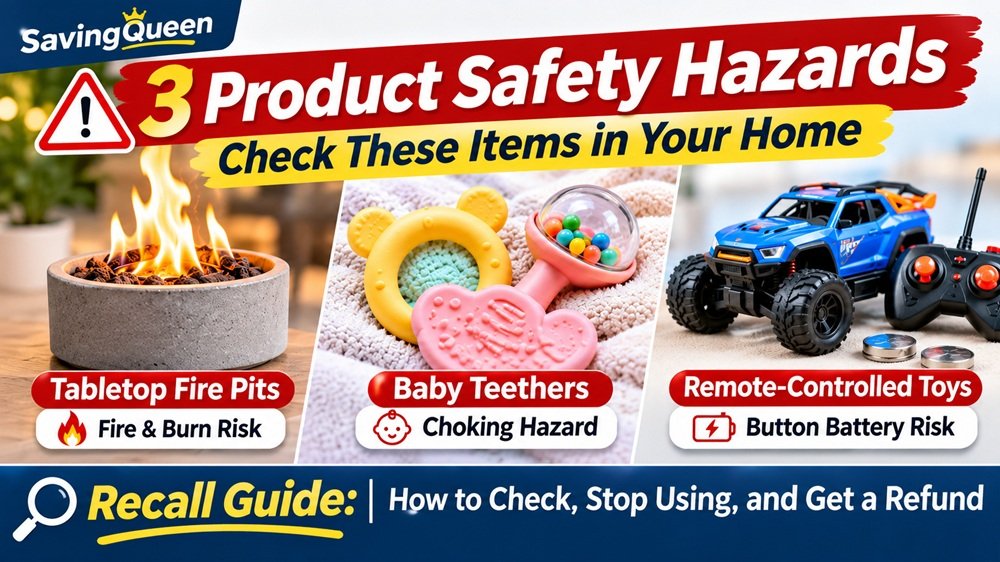
Sometimes, the items that deserve the closest attention are the ones we barely think about: a decorative tabletop fire pit, a colorful baby teether, or a remote-controlled toy car.
These products serve very different purposes, but they share one important characteristic. A hidden safety problem can turn an ordinary household item into a serious hazard.
The U.S. Consumer Product Safety Commission (CPSC) has issued recalls and safety warnings involving tabletop fire pits, infant teething toys, and products containing accessible button batteries.
Here are three risks worth checking in your home—and what to do if you discover a recalled product.
1. Tabletop Fire Pits: When a Small Flame Becomes a Serious Burn Hazard
Tabletop fire pits have become popular for patios, outdoor gatherings, and decorative home settings.
Their compact size can make them seem harmless. But certain alcohol-fueled fire pits present serious risks.
The CPSC has warned that some tabletop fire pits can produce uncontrolled flames or dangerous flame jetting.
Flame jetting can occur when someone adds liquid fuel while a flame is still present. The flame can ignite vapor inside the fuel container, potentially sending burning liquid toward nearby people.
In July 2026, the CPSC warned consumers to stop using Houswise tabletop fire pits because of fire and burn hazards.
The agency also previously announced a recall involving Colsen-branded tabletop fire pits.
What you should do:
- Check the brand and model of any tabletop fire pit you own.
- Look for an official recall or safety warning.
- Stop using the product immediately if it matches an affected model.
- Never add liquid fuel to a burning or potentially hot fire pit.
- Follow the specific CPSC instructions for disposal or other remedies.
A decorative flame should never be treated as risk-free simply because the device is small.
2. Baby Teethers: Small Design Problems Can Create Big Risks
Baby teethers and rattles are designed to be handled, chewed, and explored by infants.
That makes product design especially important.
In September 2026, SHEIN Distribution Corporation recalled approximately 644 Pull & Chew Montessori Teething Toys because their silicone strings violated mandatory toy safety requirements.
According to the CPSC, the strings could reach the back of a child’s throat and become lodged, creating a serious choking hazard.
Affected products were sold through SHEIN.com from December 2025 through April 2026.
The recall offered refunds, with specific instructions for documenting destruction of the affected toys.
What parents should do:
- Remove any suspected recalled toy from the child’s reach.
- Compare its appearance and product SKU with the official recall notice.
- Check previous online orders for product information.
- Follow the company’s official refund instructions.
- Do not donate, resell, or pass along recalled toys.
The most important lesson is that a baby product does not have to appear broken to be unsafe.
3. Remote-Controlled Toys: Check the Button Battery Compartment
Remote-controlled cars and other electronic toys can contain small batteries.
Some devices use button cell or coin batteries, which present a particularly dangerous ingestion risk.
The CPSC warns that swallowed button batteries can cause severe internal chemical burns and potentially fatal injuries.
Children may access these batteries when a compartment is unsecured, damaged, or easy to open.
This is not limited to toy cars. Similar batteries are found in remote controls, electronic decorations, key fobs, and other household products.
What you should do:
- Inspect battery compartments on electronic toys and remotes.
- Check whether battery covers are properly secured.
- Keep loose batteries away from children.
- Stop using any product subject to a battery-ingestion recall or safety warning.
- Follow the official remedy rather than attempting an unauthorized repair.
Emergency warning: If you suspect a child has swallowed a button battery, seek emergency medical care immediately. Do not wait for symptoms.
You can also contact the National Battery Ingestion Hotline at 800-498-8666 for guidance.
How to Check Whether a Product Has Been Recalled
You don’t need to wait for an email from the retailer.
The CPSC maintains a searchable database of recalls and product safety warnings.
- Visit CPSC.gov/Recalls.
- Search by product name, brand, or model number.
- Compare the official product description with the item you own.
- Check the affected sales dates and identifying information.
- Follow the manufacturer’s official recall remedy.
Keep in mind that a recall may apply only to certain models, production batches, or sales periods.
Can You Get a Refund Without a Receipt?
Possibly.
Some recalls offer refunds without requiring the original receipt. Others require a product photograph, identifying label, purchase record, or proof of destruction.
There is no single refund procedure that applies to every recall.
Before disposing of a recalled product, read the official instructions carefully. If the item is dangerous, stop using it and keep it safely away from children while completing the required steps.
The SavingQueen Takeaway: A Good Deal Should Also Be a Safe Deal
Saving money is about more than finding the lowest price.
A discounted product is not a good value if it creates an avoidable safety risk.
Before buying children’s products, battery-powered toys, or devices involving open flames, take a moment to review available safety information.
And if you already own one, checking for recalls takes only a few minutes.
Save smart. Shop carefully. Stay safe.
Official Sources
- CPSC Recall Database
- SHEIN Pull & Chew Montessori Teething Toy Recall
- CPSC Houswise Tabletop Fire Pit Warning
- CPSC Button Battery Safety Information
Editorial note: This article discusses verified product safety warnings and recalls. It does not establish that every tabletop fire pit, baby teether, or remote-controlled car is subject to a recall.