
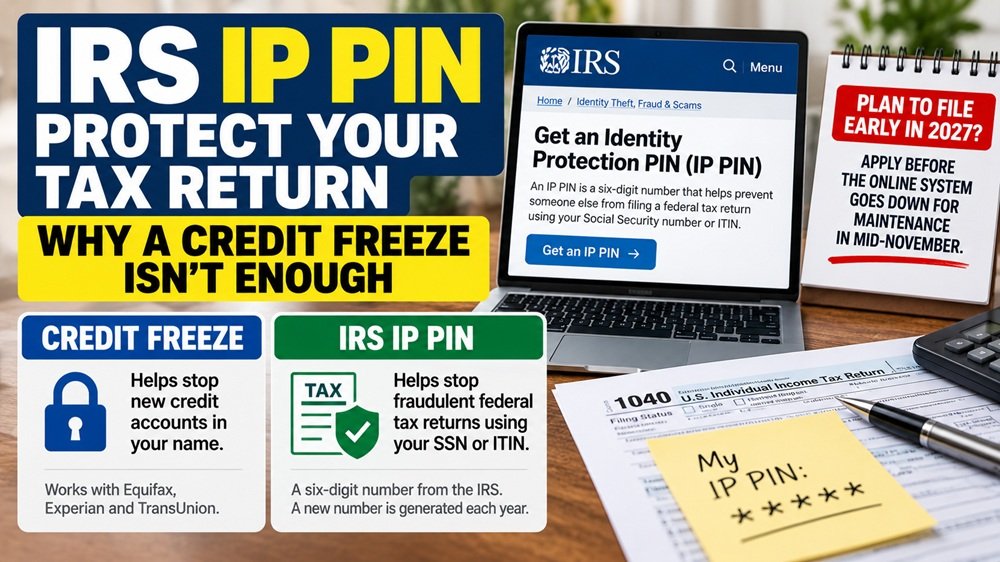
If someone steals your Social Security number, freezing your credit is one of the most useful steps you can take.
But a credit freeze does not solve every identity-theft problem. It is mainly designed to make it harder for someone to open a new credit account in your name.
It does not authenticate the federal tax return filed under your Social Security number.
For that, the IRS has a different tool: the Identity Protection Personal Identification Number, or IP PIN.
On October 22, 2026, the IRS again encouraged taxpayers to obtain an IP PIN as a proactive defense against tax-related identity theft. The timing is important because taxpayers planning to file early in 2027 are being advised to request one before the online system goes down for annual maintenance in mid-November.
What exactly is an IRS IP PIN?
An IP PIN is a six-digit number known only to you and the IRS.
Its purpose is simple: it helps the IRS verify that a federal income tax return filed using your Social Security number, or SSN, or Individual Taxpayer Identification Number, or ITIN, is really yours.
If an identity thief obtains your name, date of birth and Social Security number and tries to file a fraudulent federal tax return in your name, the thief would also need the correct IP PIN for a return that requires one.
A new IP PIN is generated each year, so it is not a permanent number like your Social Security number.
You do not have to be an identity-theft victim to get one
This is one of the biggest misconceptions about the program.
IP PINs were once primarily associated with people who had already experienced tax-related identity theft. Today, however, the program is available much more broadly.
The IRS says anyone with an SSN or ITIN who can verify their identity can enroll in the IP PIN program.
You can request one even if:
- You have never experienced identity theft
- Your Social Security number has never been reported stolen
- You are not currently required to file a federal income tax return
- You simply want additional protection before a problem occurs
Confirmed victims of tax-related identity theft may be automatically enrolled by the IRS after their cases are handled.
Credit freeze vs. IRS IP PIN: they protect different doors
This is probably the most important distinction to understand.
A credit freeze restricts access to your credit report. Since lenders normally check a credit report before approving a new credit card or loan, the freeze can make it much harder for an identity thief to open a new account in your name.
An IRS IP PIN, on the other hand, helps authenticate a federal income tax return filed with your SSN or ITIN.
A simple way to think about it is:
Credit Freeze → Helps protect new credit accounts
IRS IP PIN → Helps protect your federal tax return
If your Social Security number was exposed in a data breach, the two protections can therefore address different risks.
Putting a freeze on your credit does not tell the IRS who is authorized to file your tax return, and getting an IP PIN does not freeze your Equifax, Experian or TransUnion credit files.
Why tax identity theft can create such a headache
Tax identity theft can occur when someone uses stolen personal information to file a federal tax return before the legitimate taxpayer does.
The fraudster may attempt to claim a refund using the victim’s identity.
The legitimate taxpayer might not discover the problem until trying to file and learning that the IRS has already received a return associated with that SSN or ITIN.
An IP PIN adds an authentication number to the filing process before that situation occurs.
How to get an IP PIN
The fastest method is through your IRS Individual Online Account.
The basic process is:
- Go directly to IRS.gov/IPPIN.
- Sign in to or create your IRS Individual Online Account.
- Complete the required identity verification.
- Open the IP PIN section under your Profile.
- Enroll and obtain your six-digit IP PIN.
The IRS currently provides online users with two enrollment choices.
Continuous enrollment keeps you enrolled for future years, with a new IP PIN generated annually.
One-time enrollment protects you for the current calendar year and automatically ends at the end of that calendar year.
If you cannot complete the online identity-verification process, the IRS also provides alternative procedures for eligible taxpayers, including Form 15227 and an in-person Taxpayer Assistance Center option.
Want to file early in 2027? Don’t wait too long
This is especially relevant right now.
In its October 22, 2026 reminder, the IRS said taxpayers who plan to file early in 2027 should request an IP PIN before the online system becomes unavailable for annual maintenance in mid-November.
The IRS says the system is generally available again beginning in mid-January.
The agency did not give one fixed shutdown date in that announcement, so don’t treat a date circulating on social media as the official deadline unless the IRS publishes it.
If you want an IP PIN for early filing, the practical approach is simply to apply before the mid-November maintenance period begins.
You’ll get a new IP PIN every year
Do not save this year’s six-digit number and assume you can reuse it forever.
The IRS generates a new IP PIN every calendar year.
Taxpayers who enrolled online generally retrieve the current year’s number through their IRS Online Account.
If you receive an IRS CP01A notice, that notice may contain your new IP PIN.
The current year’s IP PIN is the one that matters when you file during that calendar year, including certain prior-year returns filed during the same year.
If the IRS issued you an IP PIN, don’t leave it off your return
Once an IP PIN applies to you, it is not an optional field that you can simply ignore when filing.
If an electronic return requires an IP PIN and the correct number is missing or entered incorrectly, the IRS can reject the e-filed return.
If you file a paper return without the required IP PIN, the IRS may have to perform additional identity verification, which can delay processing and potentially delay a refund.
The same general IP PIN requirement also applies to amended federal income tax returns.
What about a married couple?
An IP PIN belongs to an individual taxpayer, not to the household.
If a married couple files jointly and only one spouse has an IP PIN, that spouse’s IP PIN must be included with that taxpayer’s information.
If both spouses have IP PINs, each taxpayer enters their own number.
Dependents can also have IP PINs, and special rules apply when their numbers are included on electronically filed returns.
What if you lose your IP PIN?
If you already have an IP PIN but cannot find it, don’t request a completely new enrollment through Form 15227.
The IRS says the quickest option is to sign into your Online Account and retrieve the current IP PIN from your Profile.
If you cannot retrieve it online, the IRS provides specialized telephone assistance for reissuing an IP PIN after identity verification.
Be aware that reissuance by mail can be restricted during the annual year-end maintenance period.
An IP PIN will not make your refund arrive faster
An IP PIN is a security tool, not a priority-processing service.
The IRS says using an IP PIN does not automatically move your return ahead of other tax returns or guarantee a faster refund.
Its value is in helping the IRS authenticate the person filing under your SSN or ITIN.
Never give your IP PIN to someone who calls or texts you
Once you receive the number, treat it like sensitive financial information.
The IRS says it will never call, email, text or contact you through social media to ask for your IP PIN.
You should generally disclose it only when your trusted tax professional or tax software needs the number to prepare and submit your federal tax return.
If someone unexpectedly contacts you claiming to be from the IRS and asks for your six-digit IP PIN, that request itself is a warning sign.
Should you get an IP PIN after a data breach?
If a breach exposed your Social Security number, it is useful to think about the different ways that permanent identifier could be misused.
A practical protection map looks like this:
New loan or credit-card fraud → Credit freeze
Fraudulent federal tax return → IRS IP PIN
Existing bank account fraud → Contact the bank
Actual identity theft → IdentityTheft.gov recovery plan
One tool does not replace all the others.
That is why “I already froze my credit” should not automatically end your identity-theft checklist if your Social Security number was exposed.
The SavingQueen takeaway
An IRS IP PIN is one of the simpler preventive tools available for tax-related identity theft.
You don’t need to wait until someone files a fraudulent return in your name. If you have an SSN or ITIN and can verify your identity, you can proactively request one.
The most important distinction is:
A credit freeze protects your credit file. An IP PIN protects the identity verification step on your federal tax return.
For taxpayers planning to file early in 2027, timing also matters. The IRS is specifically recommending that new users request an IP PIN before the online system goes into its annual maintenance period in mid-November 2026.
Then keep the number private, retrieve the new IP PIN each year, and make sure the correct number is entered whenever your federal tax return requires it.
Current IRS reminder: October 22, 2026
IP PIN length: Six digits
Who can enroll: Taxpayers with an SSN or ITIN who can verify identity
Cost: Free
New number: Generated each year
Primary purpose: Prevent misuse of an SSN or ITIN on fraudulent federal tax returns
2026 seasonal note: Online system generally goes down for maintenance in mid-November and returns around mid-January