
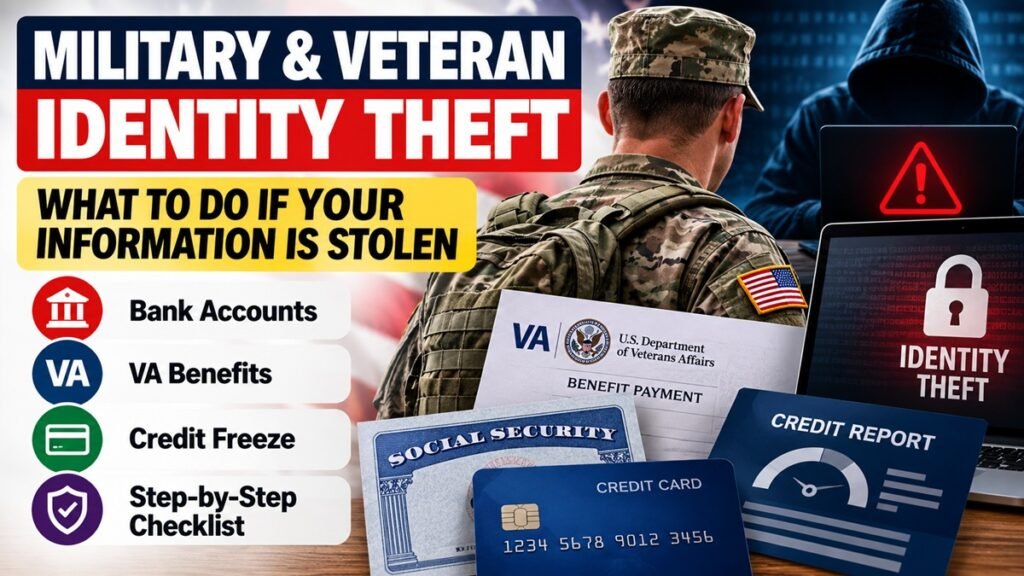
If you are a servicemember or Veteran and discover that someone may have your Social Security number, bank information, VA account details, or other personal information, changing your password is important—but it may not be enough.
Identity theft can affect several parts of your financial life at the same time: your existing bank accounts, your VA benefits, and your credit file. The best response depends on what information was stolen and whether the thief has already used it.
A recent federal criminal case illustrates the risk. On October 20, 2026, the U.S. Department of Justice announced that a defendant pleaded guilty for his role in a fraud scheme involving stolen personal information belonging to thousands of U.S. servicemembers and Veterans. According to DOJ, the information was used to compromise bank accounts and steal both money and Veterans’ benefits.
The lesson is not to panic. It is to check the right places in the right order.
Military and Veteran identity theft can involve more than your credit
Many people hear “identity theft” and immediately think about someone opening a new credit card in their name.
That is one possibility, but military and Veteran identity theft can also involve an account you already have.
A thief who obtains enough personal information may try to:
- Access an existing checking or savings account
- Change contact or direct-deposit information
- Open a credit card or loan in your name
- Take over an online account
- Redirect a VA benefit payment
- Use your information in another type of fraud
This distinction matters because a credit freeze helps stop new credit accounts, but it does not automatically stop someone who already has access to your bank account or VA account.
That is why the first question should be: What has already been compromised?
Step 1: Contact your bank or card company first if money is moving
If you see an unfamiliar withdrawal, transfer, debit-card transaction, credit-card charge, or account change, contact the financial institution’s fraud department immediately.
Do not use a phone number, email link, or text supplied by the person who contacted you. Go directly to the financial institution’s official website or use the number printed on your card or statement.
Tell the bank that you believe your identity or account information may have been compromised.
Depending on the situation, ask whether the institution should:
- Freeze or restrict the affected account
- Lock or replace a debit or credit card
- Stop or investigate a transfer
- Change your account number
- Reset online banking credentials and PINs
Timing can matter when money has already left an account, so this step generally should not wait while you work through the rest of the identity-theft process.
Step 2: Check your VA benefits and direct-deposit information
For Veterans and beneficiaries, financial-account monitoring is only part of the job.
Log in through the official VA website and review important account information, including your contact information and benefit-related direct-deposit details.
Pay particular attention if:
- A VA payment is missing
- Your benefit amount unexpectedly changed
- Your direct-deposit information changed
- You received a notice about an update you did not make
- Your address, phone number, or other personal information changed without your authorization
- You see a benefit claim or activity you don’t recognize
VA specifically warns Veterans to take unexpected changes to direct-deposit or account information seriously.
If something looks wrong, contact VA through an official VA.gov contact channel rather than responding to an email, text, or caller claiming to represent VA.
Step 3: Change compromised passwords—but don’t stop there
If someone may have accessed an online account, change the password as soon as possible.
Use a new, unique password that you have not used on another account. If the same password was used elsewhere, change it on those accounts too.
Turn on multi-factor authentication whenever it is available.
For VA online services, VA recommends modern secure sign-in options that support multi-factor authentication, such as Login.gov or ID.me.
Also review the account’s security settings for unfamiliar:
- Email addresses
- Phone numbers
- Devices
- Recovery methods
- Authorized users
Changing the password blocks one door. Checking the rest of the account tells you whether the thief already changed something while inside.
Step 4: Decide whether you need a credit freeze
If your Social Security number or other identity information may have been stolen, consider protecting your credit reports.
A credit freeze limits access to your credit report, making it much harder for an identity thief to open a new credit account in your name.
Important points:
- A credit freeze is free
- It does not lower your credit score
- Anyone can place one
- It stays in place until you lift or remove it
- You must contact Equifax, Experian, and TransUnion separately to freeze all three credit reports
If you later need to apply for a mortgage, car loan, credit card, or another product requiring a credit check, you can temporarily lift the freeze.
Credit freeze and fraud alert are not the same thing
A fraud alert and a credit freeze both help protect your credit, but they work differently.
A fraud alert tells a lender to take additional steps to verify your identity before opening new credit. An initial fraud alert is free and generally lasts one year.
Unlike a credit freeze, you only need to contact one of the three nationwide credit bureaus to place an initial fraud alert. That bureau must notify the other two.
If you have already experienced identity theft, an extended fraud alert may also be available.
You can have a credit freeze and a fraud alert at the same time.
Active-duty servicemembers have another option
Active-duty military personnel have an additional protection called an active duty fraud alert.
The alert tells businesses to verify your identity before opening new credit in your name. It lasts one year and can be renewed for the length of a deployment.
To place an active duty alert, an eligible servicemember only needs to contact one of the three nationwide credit bureaus. That bureau must notify the others.
FTC guidance also notes that eligible active-duty servicemembers can have access to free electronic credit monitoring, which can help flag significant changes to their credit files.
Credit monitoring, however, is an alert system—not a substitute for a credit freeze when your goal is to make it harder for a thief to open new credit.
Step 5: Check all three credit reports
Review your credit reports for accounts or activity you do not recognize.
Look for:
- Credit cards you didn’t open
- Loans you didn’t apply for
- Collection accounts that aren’t yours
- Addresses you don’t recognize
- Unexpected hard credit inquiries
The federal identity-theft recovery process recommends reviewing your reports carefully because fraudulent accounts can sometimes appear before you receive a bill or collection notice.
Keep a list of anything suspicious. You will use that information when reporting and disputing the identity theft.
Step 6: Report the identity theft at IdentityTheft.gov
If someone actually used your identity, report the theft through the Federal Trade Commission’s IdentityTheft.gov.
The site asks what happened and creates a recovery plan based on your situation.
It can also generate an FTC Identity Theft Report, which can become an important document when you need to dispute fraudulent accounts or prove to a business that the debt or transaction was caused by identity theft.
Your plan may include steps for:
- Closing fraudulent accounts
- Blocking fraudulent information from your credit reports
- Contacting creditors
- Replacing compromised identification
- Sending letters and supporting documents
Keep copies of the Identity Theft Report, correspondence, account statements, screenshots, emails, texts, and any other evidence related to the theft.
Step 7: Keep watching even after the immediate problem is fixed
Identity theft is not always a one-time event.
If a thief has your name, Social Security number, date of birth, or other permanent information, those details can potentially be reused later.
Continue monitoring:
- Bank and credit-card transactions
- VA benefit payments
- VA contact and direct-deposit information
- Your credit reports
- Unexpected bills or collection notices
- Password-reset or login alerts you did not request
Also be cautious if someone contacts you after the original fraud claiming they can “recover” your stolen money for an upfront fee. Victims of one fraud can sometimes be targeted again by recovery scams.
A simple response order can make the process easier
If several things appear wrong at once, the recovery process can feel overwhelming.
One way to organize it is:
Money moving now → Bank or card company
VA payment or account changed → Verify directly with VA
Passwords exposed → Reset credentials and enable MFA
SSN or identity information exposed → Consider credit freeze
Unknown credit activity → Review all three credit reports
Identity actually misused → IdentityTheft.gov recovery plan
The order may vary depending on what happened, but the important point is that one action does not solve every type of identity theft.
The SavingQueen takeaway
For servicemembers and Veterans, identity theft can reach beyond an ordinary credit-card account. It can affect bank accounts, credit and earned VA benefits.
If you discover suspicious activity, first stop any immediate movement of money. Then verify your VA account information, secure your online accounts, review your credit, and use the federal identity-theft recovery process if your information has actually been misused.
And remember one important distinction: a credit freeze can help prevent new-account fraud, but it cannot recover money already stolen from a bank account or automatically fix a compromised VA benefits account.
Matching the response to the type of fraud is what makes an identity-theft recovery plan effective.