The holiday season is approaching, and the temptation to spend is everywhere.
Black Friday discounts, holiday gifts, family gatherings, travel reservations, and limited-time promotions can make it difficult to stick to a budget.
A $50 purchase doesn’t seem particularly expensive. Neither does another $75 purchase a few days later.
But when the credit card statement arrives in January, those individual decisions can add up to a surprisingly large balance.
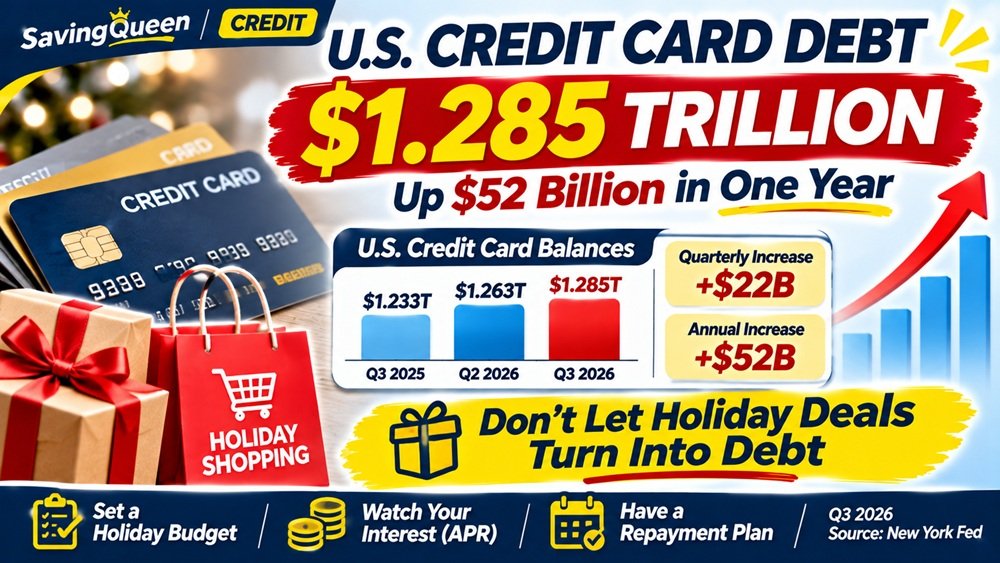
According to the Federal Reserve Bank of New York’s latest Household Debt and Credit Report, released on November 10, 2026, Americans collectively owe $1.285 trillion in credit card balances.
The latest numbers reveal an important lesson about borrowing, spending, and financial security—especially as we enter the busiest shopping season of the year.
1. How Much Credit Card Debt Do Americans Have?
The New York Fed reported that outstanding credit card balances increased by $22 billion during the third quarter of 2026.
Compared with the same period last year, balances increased by $52 billion.
| Credit card balance | Amount |
|---|---|
| Q3 2025 | $1.233 trillion |
| Q2 2026 | $1.263 trillion |
| Q3 2026 | $1.285 trillion |
| Annual increase | $52 billion |
| Quarterly increase | $22 billion |
Total U.S. household debt, including mortgages, student loans, auto loans and other borrowing, reached approximately $19.1 trillion.
However, the credit card balance figure requires careful interpretation.
Not every dollar reported as an outstanding credit card balance is necessarily accruing interest. Some consumers pay their statement balances in full every month.
The national balance includes amounts reported on consumer credit records, not exclusively long-term revolving debt.
Nevertheless, the growing total provides a useful reminder to monitor how much we borrow and how quickly we repay it.
2. Is Credit Card Delinquency Getting Worse?
Interestingly, the latest report does not show every credit card indicator moving in the same direction.
| Indicator | Q3 2025 | Q3 2026 |
|---|---|---|
| Credit card balances | $1.233 trillion | $1.285 trillion |
| Flow into serious delinquency | 7.05% | 6.87% |
The annualized rate of balances newly transitioning into serious delinquency—90 days or more past due—declined slightly.
That does not mean 6.87% of all credit card users are currently delinquent. It is a specific measure of balances moving into serious delinquency.
The New York Fed’s accompanying analysis also found that payment difficulties remain more pronounced in lower-income neighborhoods, with the gap widening since 2022.
In other words, modest improvements in national delinquency indicators do not mean every household is financially secure.
For individual consumers, the most important question is whether their own income can comfortably support their obligations.
3. Why Credit Card Debt Can Grow So Quickly
Credit cards make it easy to separate the moment of purchase from the moment of payment.
That convenience can be beneficial when managed carefully.
However, it can also make spending feel less immediate.
Suppose you make the following holiday purchases.
| Holiday expense | Amount |
|---|---|
| Gifts | $400 |
| Holiday meals | $200 |
| Travel expenses | $350 |
| Decorations | $100 |
| Black Friday purchases | $250 |
| Total | $1,300 |
Each expense may seem reasonable individually.
Together, they create a substantial financial obligation.
If you cannot pay the balance in full when the statement is due, some or all of those purchases may begin accruing interest, depending on your card’s terms and grace period.
That’s when holiday spending can turn into a financial burden that lasts well beyond the holidays.
4. What Does a 24% Credit Card APR Actually Cost?
Annual Percentage Rate, or APR, is one of the most important numbers on your credit card statement.
Let’s assume a hypothetical credit card charges a 24% APR.
Using a simplified monthly interest rate of 2%, the approximate interest on an unchanged balance would be:
| Outstanding balance | Approximate monthly interest |
|---|---|
| $500 | $10 |
| $1,000 | $20 |
| $2,500 | $50 |
| $5,000 | $100 |
| $10,000 | $200 |
A $5,000 balance could generate approximately $100 in interest during a month if the balance remains unchanged.
These examples are illustrative. Actual interest charges depend on daily balances, billing-cycle length, payments, applicable APRs, and the card issuer’s calculation method.
The key point is that debt becomes more expensive the longer you carry it.
5. Why a Black Friday Discount Can Disappear
Imagine purchasing a television originally priced at $1,000 during a Black Friday sale for $800.
You immediately save $200.
But what happens if you finance the purchase with a credit card charging 24% APR?
Assuming monthly interest compounding, no new purchases, and fixed monthly payments:
| Repayment period | Approximate monthly payment | Total interest | Actual purchase cost |
|---|---|---|---|
| Paid in full within applicable grace period | $800 | $0 | $800 |
| 6 months | $143 | $57 | $857 |
| 12 months | $76 | $108 | $908 |
| 24 months | $42 | $215 | $1,015 |
By spreading the payments over two years, the purchase could ultimately cost more than its original $1,000 price.
Actual credit card charges may differ, and the example assumes the scheduled payments satisfy the issuer’s minimum payment requirements.
A discount is not necessarily a saving if interest consumes it.
Before buying something on sale, ask yourself whether you are reducing the purchase price or simply extending the payment period.
Credit Card Interest Calculator
Find out how much your credit card purchase really costs, including interest.
This calculator provides educational estimates based on fixed monthly payments, monthly compounding, a constant APR, no new purchases, and no additional fees. Actual credit card interest, minimum payments, and repayment costs may differ. Payments shown are rounded.
6. Does Earning Cash Back Justify Carrying a Balance?
Credit card rewards can make purchases more economical—but only under the right conditions.
Consider a $1,000 purchase with a card offering 2% cash back and charging a hypothetical 24% APR.
| Item | Amount |
|---|---|
| Purchase | $1,000 |
| Cash-back reward | $20 |
| Approximate interest for one month on the unchanged balance | $20 |
One month of interest could offset the entire cash-back reward.
If you continue carrying the balance, additional interest could make the transaction more expensive.
Rewards are most valuable when you purchase things you genuinely need and avoid interest charges.
Spending $100 to earn $2 is not saving money if you would not otherwise have made the purchase.
7. Minimum Payments Are Not a Debt Repayment Strategy
Your monthly credit card statement generally includes three important figures:
- Current balance: The outstanding posted balance, including transactions since the last statement.
- Statement balance: The balance recorded at the end of the last billing cycle.
- Minimum payment: The smallest required payment for that billing period.
Paying the minimum on time generally helps keep the account current, but it does not necessarily prevent interest charges.
The minimum payment may cover interest and only a relatively small portion of the principal.
If you have a purchase grace period and are eligible for it, paying the full statement balance by the due date can generally help you avoid interest on purchases.
If you are already carrying debt, consult your card issuer about how to restore your grace period and whether residual interest may apply.
Review the minimum-payment warning on your statement. It can help you understand how long repayment may take and how much interest you could pay.
8. Establish a Holiday Budget Before Shopping
Instead of deciding what you can afford by looking at your available credit limit, start with your actual income and necessary expenses.
Here is an illustrative monthly budget.
| Category | Amount |
|---|---|
| Monthly take-home income | $4,500 |
| Housing | −$1,800 |
| Groceries and utilities | −$750 |
| Transportation | −$400 |
| Insurance and medical expenses | −$350 |
| Existing debt payments | −$450 |
| Emergency and retirement savings | −$300 |
| Remaining discretionary money | $450 |
In this example, the household has $450 remaining for discretionary expenses.
Creating a $1,300 holiday shopping list would exceed available monthly funds unless money had already been saved or other expenses could reasonably be reduced.
A credit limit of $10,000 does not mean the household can afford to spend $10,000.
Your spending limit should be based on your budget, not your available credit.
9. The 30-Day Credit Card Spending Challenge
If you want to avoid holiday debt, try this simple four-week routine.
Week 1: Know what you owe
Review every credit card and record its balance, APR, payment due date, and minimum payment.
Determine whether you are paying interest on any existing balances.
Week 2: Create a complete holiday spending list
Include gifts, meals, travel, shipping, decorations, and entertainment.
Set a firm spending limit before comparing sales.
Week 3: Review your purchases
Check transactions regularly rather than waiting for the monthly statement.
Remove unnecessary purchases and subscriptions from your budget.
Week 4: Prepare for your next payment
Set aside the money you need for your statement.
If you cannot pay the balance in full, establish a realistic repayment plan and avoid adding unnecessary new debt.
The goal is to reach January without discovering financial obligations you were not prepared to handle.
10. Already Carrying Credit Card Debt? Choose a Repayment Strategy
Two commonly used debt repayment methods are the debt avalanche and debt snowball.
Consider these three hypothetical credit card balances.
| Credit card | Balance | APR |
|---|---|---|
| Card A | $3,000 | 29% |
| Card B | $1,500 | 24% |
| Card C | $500 | 19% |
| Total | $5,000 |
Debt Avalanche
Make required payments on all three cards and direct additional money toward Card A, which has the highest APR.
This approach generally minimizes interest costs when payment amounts and other conditions are comparable.
Debt Snowball
Make required payments on all cards and direct additional money toward Card C, which has the smallest balance.
Paying off a smaller debt first may provide motivation to continue.
Neither method works particularly well if you continue adding new debt as quickly as you repay existing balances.
Choose a strategy you can sustain while protecting essential expenses and maintaining required payments.
11. What About a 0% Balance Transfer?
A balance transfer can potentially reduce interest expenses, but it is not automatically free.
Suppose you transfer $5,000 to a card offering a genuine 0% introductory APR for 15 months, with a 3% balance transfer fee.
| Item | Amount |
|---|---|
| Original balance | $5,000 |
| Transfer fee | $150 |
| New balance | $5,150 |
| Monthly payment to repay within 15 months | $343.33 approximately |
Budgeting at least $344 per month would help repay the balance within the promotional period under these assumptions.
Before applying, check the transfer fee, promotional expiration date, post-promotion APR, minimum payment requirements, and whether new purchases will incur interest.
Also distinguish genuine introductory 0% APR offers from deferred-interest financing, which can operate differently.
A balance transfer is useful when it supports a repayment plan—not when it creates more room for additional spending.
12. What If You Can’t Make Your Credit Card Payment?
The Consumer Financial Protection Bureau recommends contacting your credit card issuer immediately if you expect difficulty making required payments.
Explain your financial situation and ask whether payment assistance or a hardship program is available.
You do not need to wait until you are already delinquent to request help.
Depending on your circumstances, an issuer may offer payment arrangements or other forms of assistance.
Reputable nonprofit credit counseling services may also help you review your finances and evaluate repayment options.
Be cautious of debt relief companies that guarantee they can eliminate your balances or pressure you to stop communicating with your creditors.
13. Save or Skip: Your Holiday Credit Card Checklist
| Financial decision | SavingQueen verdict |
|---|---|
| Paying the full statement balance when affordable | SAVE |
| Comparing the total cost, including interest | SAVE |
| Setting payment reminders | SAVE |
| Using rewards for planned purchases | SAVE |
| Buying something simply to earn cash back | SKIP |
| Carrying unnecessary debt for holiday gifts | SKIP |
| Opening a new card solely for a store discount | REVIEW FIRST |
| Using a balance transfer without a repayment plan | SKIP |
Before completing a holiday purchase, ask three questions:
- Would I buy this item without the special promotion?
- Can I pay for it without disrupting essential expenses?
- What will it actually cost if I cannot pay my credit card balance in full?
If you cannot answer those questions comfortably, the purchase deserves another look.
The Bottom Line
America’s $1.285 trillion in credit card balances is a significant economic statistic.
But your personal financial future is shaped less by national debt figures than by the financial decisions you make every day.
There is nothing wrong with using credit cards to earn rewards, simplify payments, or take advantage of legitimate consumer protections.
The challenge is making sure credit remains a financial tool rather than a substitute for income.
Enjoy the holidays. Buy thoughtful gifts. Spend time with your family.
But remember that a celebration lasting a few days should not create financial stress lasting several years.
The best holiday deal is one you can afford long after the sale ends.
Frequently Asked Questions
How much credit card debt do Americans have in 2026?
According to the New York Fed, outstanding credit card balances totaled $1.285 trillion at the end of the third quarter of 2026.
Is every outstanding credit card balance accruing interest?
No. Some reported balances belong to consumers who pay their statements in full and avoid purchase interest through an applicable grace period.
Does paying the minimum prevent interest charges?
Generally, no. Paying the required minimum on time can keep the account current, but interest can continue accumulating on unpaid balances.
Should I keep a balance to improve my credit score?
No. You do not need to carry an interest-bearing balance to build a credit history.
Is a 0% balance transfer worth it?
It can be useful if the interest savings exceed applicable fees and you have a realistic plan to repay the transferred balance before the promotional period expires.
What should I do if I cannot afford my minimum payment?
Contact your credit card issuer promptly and ask about repayment assistance or hardship programs.
Official Sources and Resources
- Federal Reserve Bank of New York — Q3 2026 Household Debt and Credit Report Announcement
- New York Fed — A Look at the Wider Divide in Credit Card Delinquency by Income
- CFPB — Understanding Credit Card Grace Periods
- CFPB — Understanding Credit Card Costs
- CFPB — What to Do If You Can’t Pay Your Credit Card Bills
Last reviewed: November 20, 2026. All individual spending, APR, interest, and debt repayment examples are hypothetical. This article provides general financial education, not individualized financial advice.