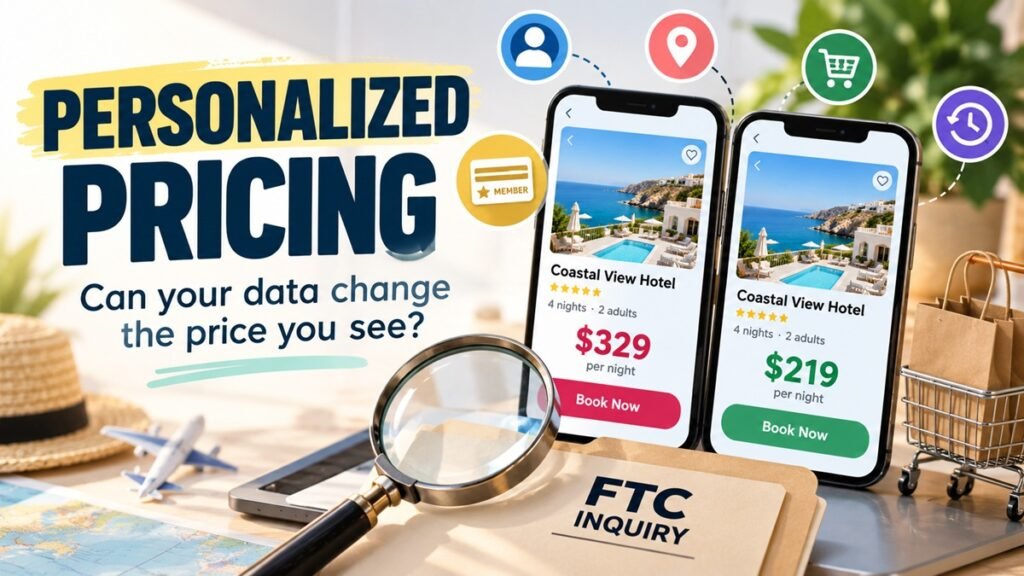
You and your spouse sit next to each other and search for the same flight.
You see $428.
Your spouse sees $397.
Did the price change because demand moved during those few seconds?
Was one account eligible for a loyalty discount?
Or did the website use information about each customer to decide what price to show?
That last possibility is called personalized pricing, and the Federal Trade Commission is now taking a closer look at it.
On October 28, 2026, the FTC ordered nine major companies in airlines, ride sharing, delivery, and retail to provide information about whether and how personal data may be used to set consumer prices or worker compensation.
But there is an important point to understand from the beginning:
The FTC has opened an inquiry. It has not concluded that the companies named in the inquiry are charging different people different prices based on their personal data.
What is personalized pricing?
Personalized pricing generally means using information about an individual consumer to determine the price that particular person is offered.
The FTC has described the concept as using personal data to estimate factors such as how much a specific customer may be willing to spend.
Potential inputs can include things such as:
- Shopping history
- Browsing activity
- Location
- Loyalty-program participation
- Previous purchases
- Past responses to discounts or offers
- Other data associated with an account or device
In a personalized-pricing scenario, two consumers could potentially look for the same product or service at roughly the same time and receive different offers because the system has different information about them.
Personalized pricing is not the same as dynamic pricing
This distinction is important.
Dynamic pricing changes prices because market conditions change.
For example:
- Airfare rises as seats sell out
- A rideshare fare increases during heavy demand
- A hotel becomes more expensive on a holiday weekend
- A concert ticket changes price as inventory changes
Everyone shopping under the same conditions may still be offered the same current price.
Personalized pricing is different.
The concern is that the price changes because of information associated with you.
A simple way to think about it is:
Dynamic pricing → “What is happening in the market?”
Personalized pricing → “What does the seller know or infer about this customer?”
The two methods could also operate together, which makes the final price difficult for a consumer to understand from the outside.
What is the FTC investigating now?
The FTC’s October 28 inquiry seeks information directly from nine companies:
- Delta Air Lines
- United Airlines
- JetBlue Airways
- Lyft
- Uber
- DoorDash
- Instacart
- Target
- Walmart
The agency wants to understand whether pricing for things such as airline tickets, rides, deliveries, and retail products can vary from one customer to another based on personal information or loyalty participation.
The orders also ask about the tools, algorithms, data inputs, and procedures companies use when adjusting prices.
The companies generally have 45 days after receiving the orders to provide the requested information.
Being named in the inquiry does not mean a company did something wrong
This is worth repeating because headlines can easily create the wrong impression.
The FTC issued the information requests under its authority to conduct market studies.
This is not the same thing as filing a complaint alleging that all nine companies violated the law.
The inquiry is intended to help the agency determine what practices actually exist.
So a shopper should not read the company list and conclude:
“FTC proved these companies charge me more because of my browsing history.”
That has not been established by this investigation.
Why is the FTC interested in browsing and shopping data?
The issue did not appear overnight.
An earlier FTC study examined companies that provide pricing technology and data services to retailers.
That research found that pricing systems can potentially use detailed consumer information such as:
- Precise location
- Demographics
- Browser history
- Shopping history
- Products placed in an online cart but not purchased
- Even certain interactions with a website
But that earlier study focused primarily on technology intermediaries rather than companies directly setting the final consumer price.
The new 2026 inquiry goes directly to businesses that actually sell products or services.
Does personalized pricing automatically violate the law?
No.
The FTC has specifically said that it does not have authority to prohibit personalized pricing in every circumstance.
The legal concern becomes stronger when consumers are misled about how a price is determined or when important information about personalization is hidden.
For example, the FTC’s proposed policy approach raises concerns when a company gives consumers the impression that everyone is seeing the same generally available price while secretly using personal data to create an individualized price.
Disclosure matters because a consumer who knows a price is personalized can make a different decision.
They might compare another retailer, sign out of an account, decline the purchase, or use another shopping method.
What about loyalty-member prices?
Not every price difference is suspicious.
You may legitimately see a different price because:
- One shopper is a loyalty-program member
- One person activated a digital coupon
- A credit card provides a special offer
- One account has reward points
- A customer qualifies for a clearly disclosed membership price
The key difference is transparency.
If a store clearly says:
Regular price: $12.99
Loyalty-member price: $9.99
the customer can understand why the price differs.
The personalized-pricing concern is more complicated when the reason for the difference is invisible.
How can you tell whether you’re seeing a personalized price?
Usually, you can’t know with certainty just by looking at one screen.
But you can compare.
For an expensive purchase such as airfare, a hotel, rental car, electronics, or a large online order, try checking the same product in more than one shopping context.
For example:
- Check the price while logged into your account.
- Open a private or incognito browser window and check again.
- If practical, compare from another device.
- Compare the merchant’s website with another retailer or marketplace.
- Look carefully for loyalty, coupon, location, delivery, or membership conditions.
If the price differs, that does not automatically prove personalized pricing.
Inventory, taxes, location, delivery fees, time, demand, promotions, and cached information can also produce different totals.
The comparison simply gives you more information before you buy.
Will incognito mode guarantee a lower price?
No.
This is an important myth to avoid.
A private or incognito browser window generally limits the browser’s use of existing cookies and prevents that session from being saved in the usual way on your device.
But it does not make you anonymous.
A website may still know things such as:
- Your general location
- Your IP address
- That you logged into an account
- Information you provide during checkout
If you sign into the same loyalty account while using incognito mode, the company may still be able to connect the activity to your account.
So private browsing can be useful as a comparison tool, but it is not proof that you will receive an unpersonalized or cheaper price.
What about using a VPN?
The FTC has noted that consumers who know personalized pricing is being used might choose tools such as private browsing or a virtual private network, or VPN, when comparing offers.
A VPN can change the internet location visible to a website.
But again, it is not a guaranteed way to obtain a lower price.
If you remain logged into the same account, use the same app, provide the same delivery address, or identify yourself another way, the merchant may still have information associated with you.
And changing location can sometimes change taxes, availability, currency, or legitimate geographic pricing.
A lower personalized price isn’t necessarily bad
Personalization does not always mean a consumer pays more.
A system could potentially give a shopper:
- A targeted coupon
- A retention discount
- A loyalty reward
- A special promotion designed to win back a customer
Those could save money.
The larger consumer issue is whether people understand that the price or discount is individualized and what data is being used to make that decision.
The inquiry also covers what gig workers are paid
The FTC’s study is not limited to customer prices.
It is also examining personalized compensation for workers in ride-sharing and food-delivery businesses.
The agency wants to know whether information such as a driver’s phone usage or history of accepting previous offers could affect the compensation offered for a new job.
Again, the inquiry is asking whether and how this occurs. It should not be described as a finding that every platform uses those factors to reduce worker pay.
For expensive purchases, use a two-minute comparison habit
You probably don’t need to conduct an experiment every time you buy toothpaste.
But for a $500 flight or a $1,000 purchase, a few extra checks can be worthwhile.
Try this:
Price → Conditions → Logged-out comparison → Competitor → Final total.
In practice:
- Write down or screenshot the first price.
- Check whether it requires membership, loyalty status, or a coupon.
- Compare the price in a logged-out or private session if practical.
- Check at least one competing seller.
- Compare the final checkout total, not just the advertised starting price.
The goal is not to prove that an algorithm is profiling you.
The goal is to make sure you have enough price information to make a good buying decision.
Take screenshots when a price matters
If you see a particularly good airfare, hotel rate, promotion, or retail price, consider taking a screenshot before moving through the checkout process.
A useful screenshot should show:
- The price
- The product or service
- The date or time when relevant
- Any membership or promotion requirements
If the final price changes, you can then determine whether something obvious changed—such as taxes, inventory, shipping, a coupon, or a loyalty requirement.
The SavingQueen takeaway
Personalized pricing sounds simple:
“The company knows who I am, so it charges me a different price.”
In reality, proving that is difficult from a single purchase.
Prices can legitimately vary because of demand, time, inventory, geography, membership status, coupons, and many other factors.
What makes the FTC’s new investigation important is that the agency is now asking companies directly:
What personal data do you use? How do you use it? And can it change the price one consumer sees compared with another?
Until those answers are available, consumers should avoid assuming either extreme.
Don’t assume every changing online price is personalized.
But don’t assume the price on your screen is necessarily the only price available either.
For purchases where the difference matters, use a simple SavingQueen routine:
Compare → Sign out → Check conditions → Check another seller → Compare the final total.
A few minutes of comparison shopping remains one of the easiest ways to make sure an algorithm—or an ordinary sale condition—isn’t making you pay more than necessary.
FTC inquiry announced: October 28, 2026
Geography: United States
Companies receiving information orders: Delta, United, JetBlue, Lyft, Uber, DoorDash, Instacart, Target and Walmart
Response period: 45 days after receipt of the orders
Status: Market inquiry; not a finding that the named companies violated the law
Main question: Whether personal data is used to set individualized prices or worker compensation