
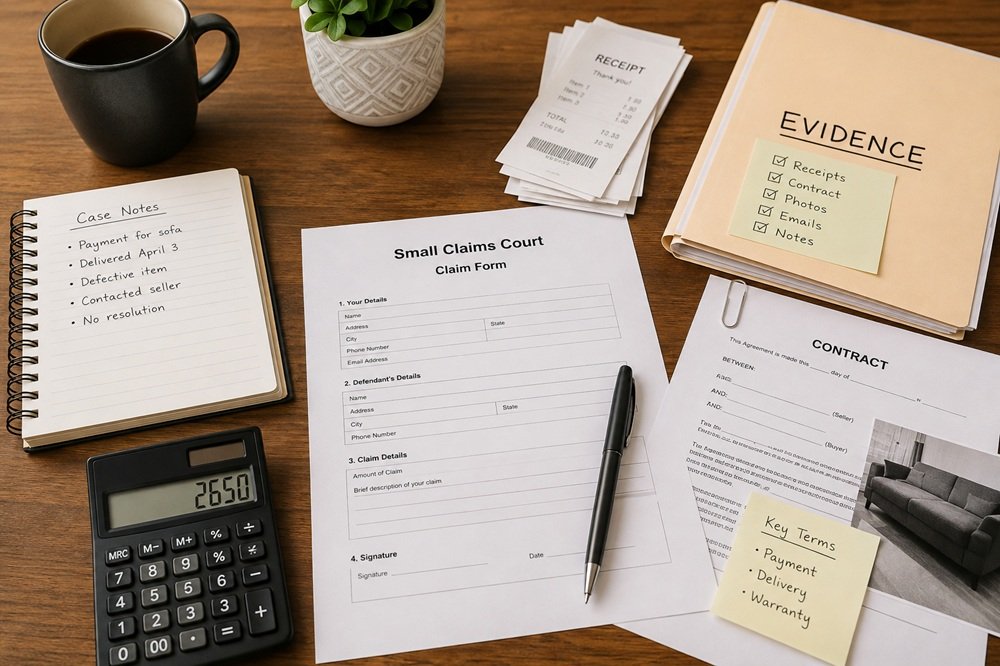
Small Claims Court can be one of the most practical ways to resolve a money dispute without paying for full-service legal representation. These courts are designed to be simpler and more accessible than ordinary civil litigation, although the exact dollar limits, filing fees, deadlines, service rules, and attorney rules depend on your state and local court.
That last point matters. In California, for example, lawyers generally cannot represent a party at a small claims trial, while New York allows parties to hire an attorney if they choose. So before you file—or respond to a case—check the official rules for the court that will actually hear your dispute.
Legal information disclosure: This article provides general educational information, not legal advice. Small claims rules vary by state and sometimes by county or city. If your case involves a large loss, complicated facts, an approaching statute of limitations, an appeal, a counterclaim, or significant financial risk, consider speaking with a qualified attorney or legal-aid organization.
How Small Claims Court Can Reduce Legal Costs
The biggest financial advantage of Small Claims Court is that the process is intended for relatively modest disputes and is generally more informal than regular civil court. The National Center for State Courts describes small claims as a way to resolve money disputes quickly without requiring a lawyer, although local procedures and monetary limits vary.
That does not mean the process is free. You may still have to pay filing fees, service fees, copying costs, transportation expenses, and possibly costs connected with collecting a judgment. Some courts also offer fee waivers for people who qualify.
California illustrates how much the numbers can vary. Its court self-help site says individuals generally may bring claims up to $12,500, while businesses generally have a lower limit of $6,250. California filing fees for many small claims currently range from $30 to $75, with a $100 fee applying in certain high-volume filing situations.
New York uses different limits depending on the court. New York City Small Claims Court can hear claims up to $10,000, while other New York City, Town, and Village Court limits can be lower.
The takeaway is simple: Small Claims Court may reduce what you spend on legal representation, but only if your claim fits your local rules.
Is Small Claims Court Right for Your Dispute?
Before filing, ask whether your problem is really the kind of dispute Small Claims Court can solve. These courts typically focus on claims for money rather than requests for a judge to force someone to perform a service, return an item, or take another specific action.
Common examples may include:
- An unpaid personal loan
- A security-deposit dispute
- Property damage
- Unpaid invoices for completed work
- A dispute over defective goods or services
- Certain landlord-tenant money claims
- Damage caused by negligence
Rules still vary. New York Courts says its small claims process is generally for money claims and cannot normally be used to force someone to take an action. California likewise describes small claims as a process for disputes in which a person, business, or government agency allegedly owes money.
Before filing, confirm three things: your court has authority to hear the type of case, your dollar amount falls within its limit, and you are filing in the correct location.
California Courts warns that filing in the wrong county can result in dismissal, potentially creating a serious problem if the applicable filing deadline expires in the meantime.
7 Smart Steps to Handle Small Claims Court Yourself
If the rules allow you to represent yourself, preparation is where the real savings happen. A straightforward Small Claims Court case can become expensive in time and missed work if you file incorrectly, serve the wrong person, or appear without organized evidence.
1. Send a Clear Demand Before Filing
Some courts expect or require you to ask the other side for payment before starting a case. California, for example, instructs potential plaintiffs to ask the other side for the money owed before moving forward.
Even when your jurisdiction does not require a formal demand, a concise written request may create a useful paper trail.
Include:
- What happened
- How much you believe you are owed
- How you calculated the amount
- A reasonable payment deadline
- Copies of important supporting documents
- A calm statement explaining that you may consider court if the matter is unresolved
Avoid threats or emotional language. Your goal is either to resolve the dispute inexpensively or demonstrate that you made a reasonable attempt before filing.
2. Identify the Correct Defendant
One of the easiest ways to create problems in Small Claims Court is to sue the wrong legal person or business entity.
A store’s sign, social-media account, or website brand may not be the legal name that belongs on your claim. California’s court guidance specifically cautions plaintiffs to list the proper legal name because getting it wrong may make collecting a judgment more difficult.
For a business dispute, check your state’s official business registry, licensing records, contracts, invoices, and other reliable documents.
3. Calculate Your Damages Carefully
Don’t simply choose a round number because it feels fair. Create a simple damages worksheet showing exactly how you arrived at your claim.
For example:
- Repair estimate: $1,250
- Replacement cost: $420
- Unpaid invoice: $900
- Recoverable filing cost: $50
- Potential total: $2,620
Only request amounts that are legally recoverable and that you can document.
Some courts may permit the winner to recover certain court fees or costs. California Courts, for example, notes that a court can order the losing side to pay qualifying court fees and costs in some situations.
4. Organize Evidence Like a Mini Case File
Your evidence should tell the story without making the judge hunt for information.
Create a folder—paper, digital, or both—with sections for:
- Timeline
- Contract or agreement
- Receipts and invoices
- Photos or videos
- Emails and text messages
- Demand letter
- Proof of payment
- Witness information
Keep your original documents safe and bring the number of copies your local court requires.
If you plan to show evidence from a phone, laptop, cloud account, or video file, check the court’s rules before the hearing. Don’t assume the courtroom will accept every digital format.
5. Follow Service Rules Exactly
Filing your Small Claims Court paperwork is only part of the process. The defendant usually must be formally notified using legally acceptable service of process.
California’s process, for example, separates filing from serving the claim and requires plaintiffs to follow specific procedures for notifying the defendant.
Don’t assume that sending a text message, personally handing over papers, or using ordinary mail automatically counts as proper service.
Check:
- Who is permitted to serve the papers
- Which service methods your court accepts
- How many days before the hearing service must occur
- Whether proof of service must be filed
A service mistake can delay your case.
6. Practice a Two-Minute Explanation
A judge may hear numerous cases during one session, so clarity matters.
Practice explaining:
- What agreement or legal duty existed
- What the other side did or failed to do
- What evidence supports your position
- How much money you want
- How you calculated that amount
Stick to relevant facts.
Instead of saying, “They’ve been impossible for months,” say, “The written agreement required payment by May 1. Exhibit B shows the invoice, and Exhibit C shows three unanswered payment requests.”
That is easier to evaluate.
7. Remember: Winning and Collecting Are Different
A court judgment establishes who owes whom money. It does not necessarily cause the money to appear in your account.
California Courts specifically notes that a person who wins a Small Claims Court case may still have to take additional steps to collect the judgment.
Collection procedures vary substantially by state and by the debtor’s financial circumstances.
Before paying a private collection service, read your court’s official post-judgment instructions and understand the available options.
When Paying for Legal Advice May Still Be Worth It
Using Small Claims Court does not have to mean getting zero legal help. In some situations, paying for a limited consultation may cost far less than hiring a lawyer to manage an entire lawsuit.
Consider obtaining legal advice when:
- You are unsure whom to sue
- The statute of limitations may be close
- The other side has filed a counterclaim
- Your evidence involves technical or expert issues
- Your contract contains arbitration or attorney-fee provisions
- A business has complicated ownership
- You could lose substantially more than you are claiming
- You do not understand the consequences of a judgment
The National Center for State Courts notes that some self-represented litigants use limited-scope legal assistance, sometimes called unbundled services, for specific parts of a case rather than full representation.
That could mean paying a lawyer for a one-hour strategy consultation or document review instead of handing over the entire case.
If cost remains a barrier, the Legal Services Corporation funds civil legal-aid organizations around the country and provides a way to locate an organization serving your area.
If You Are the Person Being Sued
Don’t ignore Small Claims Court papers.
Read every page, note the hearing or response deadline, and verify the case through the official court system if online case access is available.
This is particularly important in debt cases. The Consumer Financial Protection Bureau warns that failing to respond when a creditor or debt collector sues can result in a default judgment. Depending on applicable law, a judgment may give a creditor stronger ways to collect the debt.
Responding does not automatically mean you admit that you owe the money. The CFPB specifically notes that responding can require the debt collector to prove that the debt is valid.
If you believe the claim is wrong, gather documents supporting your position.
If you agree that you owe some or all of the money, settlement may still be possible before the hearing. Get any settlement in writing and make sure you understand what will happen to the pending court case.
Small Claims Court Mistakes That Can Cost You Money
Saving attorney fees helps only when avoidable mistakes don’t create bigger losses.
Watch for these common problems:
- Missing a filing or response deadline
- Filing in the wrong court
- Suing the wrong legal entity
- Failing to complete proper service
- Arriving without organized evidence
- Requesting damages you cannot document
- Ignoring a counterclaim
- Assuming the court automatically collects your judgment
- Failing to understand your appeal rights
Appeal rules deserve particular attention.
California, for example, generally does not permit the plaintiff who originally filed the small claims action to appeal after losing, although a defendant may have appeal rights in specified circumstances.
Your state may be different.
Free Small Claims Court Resources to Use First
Before spending money on private help, see what free resources your court already offers.
The National Center for State Courts says court-based self-help centers provide legal information, procedural guidance, and referrals for large numbers of self-represented litigants.
Depending on where you live, useful free resources may include:
- Court self-help centers
- Small claims advisers
- Filing checklists
- Guided online forms
- Legal-aid organizations
- Court-sponsored videos
- Mediation programs
- Fee-waiver applications
California Courts, for instance, provides a free guided filing program and says most California courts have a small claims adviser who provides free legal information, although available services vary.
Checking these resources first can make Small Claims Court considerably easier to navigate without automatically paying for full legal representation.
Bottom Line: Small Claims Court Can Be a Practical Money-Saver
Small Claims Court can be a smart alternative to expensive civil litigation when your dispute fits the local rules and the amount at stake is relatively modest.
The biggest savings often come from handling the administrative preparation yourself: verifying the defendant’s legal name, calculating damages, organizing evidence, completing service correctly, and preparing a concise presentation.
But saving attorney fees shouldn’t mean guessing about a serious legal issue. Start with free official court resources, consider legal aid if you qualify, and pay for targeted legal advice when one mistake could cost considerably more than the consultation.
Have you ever used Small Claims Court—or are you considering it now? Share your biggest question in the comments.
For more practical money-saving guidance, explore our Finance, Legal, and Smart Living sections.

